How Shakspere Got Connected to the Works
Not a conspiracy, a structural condition
The Stratfordian attribution was not settled by primary source documentation and then commercialised. It was commercialised first, progressively and on an enormous scale, and the scholarly apparatus was built around it afterwards. This page is an account of how that happened.
The authorship question is not radioactive because the evidence is thin. It is radioactive because a very large amount of money and professional identity now rests on the attribution being correct. That is not an accusation of conspiracy or bad faith. It is a description of a structural condition that any honest engagement with this question has to name. Sociologists call it boundary maintenance: the ordinary institutional process by which a field defines who belongs inside it and who does not, not through coordination, but through the accumulated daily decisions of editors, reviewers, hiring committees, and conference organisers, each acting normally inside a system whose defaults produce the result.
What follows is a factual account of how the commercial and institutional infrastructure was assembled. The question of whether the attribution was established correctly is separate; the historical record of how it happened is not in dispute.
The Monument (c.1616–1623)
The Shakespeare monument in Holy Trinity Church, Stratford-upon-Avon, is one of the two main props of the Stratford attribution, the other being the First Folio of 1623. The Folio’s prefatory poems contain two phrases that are routinely read as connecting the author to Stratford: Ben Jonson’s “Sweet Swan of Avon” and Leonard Digges’s reference to “thy Stratford Moniment.” Neither is as straightforward as it appears.
“Sweet Swan of Avon” is immediately followed in Jonson’s poem by the lines “And make those flights upon the banks of Thames / That so did take Eliza, and our James”, locating the author’s performances on the Thames, not on the Warwickshire Avon. Camden’s Britannia (1607) and Leland’s earlier Latin verse both document that Hampton Court (the principal royal theatre under Elizabeth and James, situated on the Thames) was anciently known as “Avon” or “Avondunum.” Jonson, who called Camden “a pupil once, a friend for ever,” is unlikely to have been unaware of this. Whether he intended “Sweet Swan of Avon” to be read as Hampton Court by those who knew their Camden, or as Stratford by those who did not, or as both simultaneously, is not established. What is established is that the phrase is not the unambiguous identification it is usually taken to be.
“Stratford Moniment” (Digges) identifies a town called Stratford (there are several in England) and the word moniment is a Spenserian usage meaning memorial generically, not necessarily a stone wall monument. The two phrases are routinely read together as mutual confirmation. They may be. But each requires the Stratford identification to be assumed before it can be read as confirming it. The two main props of the attribution lean on each other.
In its current form the monument shows a half-figure bust of a man holding a quill in his right hand, his left arm resting on a cushion above a sheet of paper. The Latin inscription above compares the subject to Nestor for wisdom, Socrates for genius, and Virgil for art. The monument is attributed on stylistic grounds to the Southwark workshop of Gheerart Janssen (Gerard Johnson Jr.), though no commission record survives. It was erected posthumously. Weever transcribed the inscription at some point between Shakspere’s death in April 1616 and Weever’s own death in 1632, the earliest firm evidence of the monument’s existence. (The narrower “1617–19” dating often quoted is a scholarly inference, not a documented date; see below.)
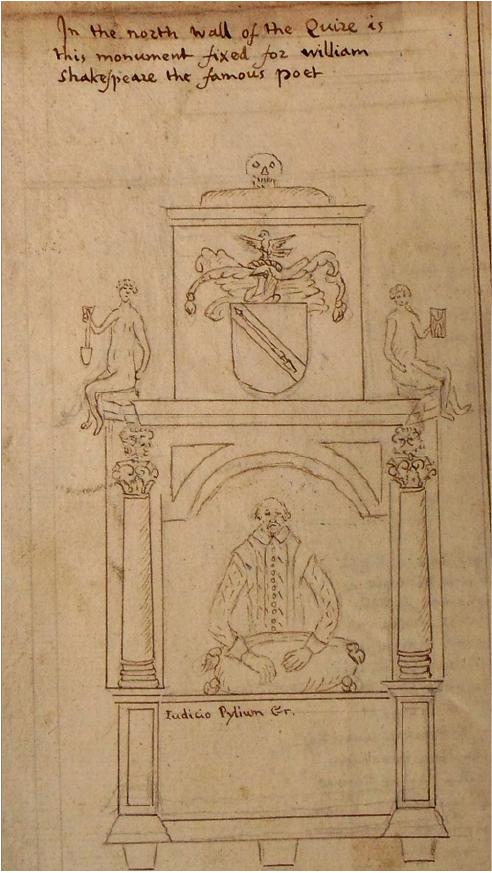
The monument’s appearance is contested. Sir William Dugdale made a sketch around 1649, later engraved by Wenceslaus Hollar for Dugdale’s Antiquities of Warwickshire (1656). In Dugdale’s sketch, and in Hollar’s subsequent engraving of it, the figure holds no quill and no paper; his arms rest on what appears to be a woolsack or cushion pressed against his body, the posture of a merchant, not a writer. Anti-Stratfordians have argued that the monument was altered at some point after 1656, that what was originally a monument to a prosperous local tradesman was refashioned to show a literary figure. The strongest counter-argument is that Hollar was a notoriously loose copyist: his engravings of other monuments contain demonstrable inaccuracies, and Stratfordians argue the Dugdale/Hollar version reflects artistic imprecision rather than a genuinely different object. A secondary consideration is George Vertue’s engraving of 1723, made for Alexander Pope’s edition of Shakespeare’s works, which shows the monument essentially as it appears today, quill and paper included. This does not refute the alteration argument (an alteration could have occurred between 1656 and 1723), but it does constrain the window within which it would have had to happen.

The Plaque Text
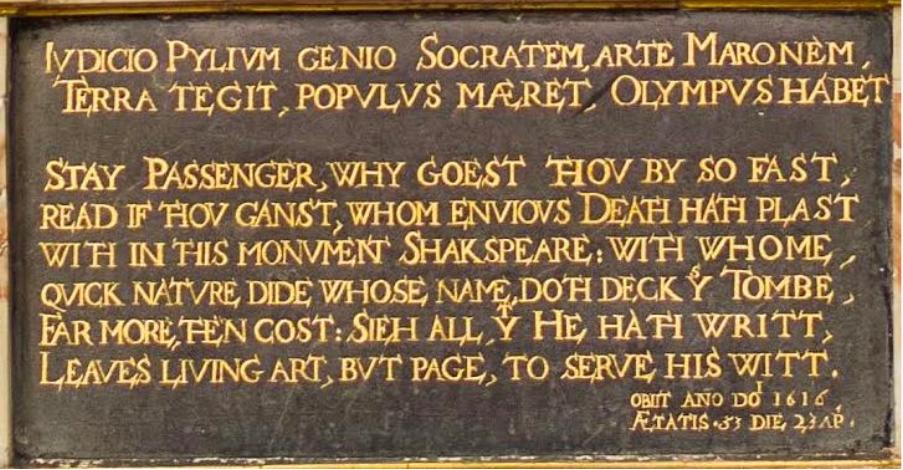
The inscription is the only text on the monument that speaks to who this man was. The Latin translates as: “In judgment a Nestor, in genius a Socrates, in art a Virgil, the earth covers him, the people mourn, Olympus holds him.”
Three things in this text reward close attention. The first is the name: the plaque spells it Shakspeare. Diana Price has documented that the spelling across title pages, the 1623 Folio, and contemporary literary commendations varies (Shake-speare, Shakespeare, Shakspeare), but not one of those variants is Shakspere, the spelling that appears in local legal records and the Stratford parish register. The standard institutional response is that Elizabethan spelling was not standardized: individuals spelled their own names inconsistently, and variation across documents is unremarkable. That is true as far as it goes. But the variation here is not random; it is patterned. Random orthographic drift would produce overlap between the literary and legal clusters; instead we find a clean separation. The legal and parish records consistently produce one cluster of spellings; the literary documents consistently produce another. Those who produced the literary documents were not using the Stratford man’s form of the name. The plaque is no exception: it spells the name Shakspeare, a literary variant, not the form found in the Stratford parish register. Even in his home church, the monument uses a literary spelling, not the local one.
The second is the phrase with in, two words, not one. The text does not say that Death placed him within the structure. It says Death placed him with in this monument, Shakspeare: the man is placed alongside or associated with the name Shakspeare through this monument. The name and the man are grammatically distinct. Whether the spacing is significant or merely a carver’s convention is a legitimate question; what is not in doubt is that the text as carved presents the name as something the monument confers upon the man, not something he arrived with. Whose name doth deck the tombe far more than cost: his name decorates this stone more than the money spent on it. The fame attached to that name is what gives the monument its value.
The third is what the plaque does not say. It never calls him a playwright. It never calls him a poet. The Latin compares him to Nestor (a counsellor and orator, whose most celebrated act of judgment was advice that led to a companion’s death), to Socrates (a philosopher who wrote nothing himself and who, in Plato’s Republic, argues for expelling poets from the ideal state), and to Virgil, an epic and pastoral poet, when the dominant classical influence on the Shakespeare canon is Ovid. None of the three classical exemplars is a dramatist.
The English text says only that he hath writt and that living art is left as a mere page to serve his witt (his intelligence, his mind), not his plays, not his theatrical output, not his dramatic invention. The monument that generations of visitors have taken as proof of the Stratford attribution does not, in its text, identify the man it memorialises as a playwright at all.
The monument was restored in 1748–49 under Parson Joseph Greene, who described the work as “reviving the Old Colouring” and replacing broken stonework. In 1793, Edmond Malone persuaded the vicar to paint it entirely white, in keeping with neoclassical taste. The original polychrome was recovered and restored in 1861. These interventions are documented; whether any of them involved structural alteration to the bust is not established.
What is not contested is this: the monument is a posthumous document, erected years after Shakspere’s death. Who commissioned it is unknown, and who made it is unrecorded, though neither is unusual for a provincial church monument of this period. What is disputed is what it was originally intended to show. It records what those who erected it wished to be remembered, or what the community had come to associate with the name, not what contemporaneous primary sources establish. The Dugdale discrepancy is real, whatever its cause. And the chain of testimony that runs from the monument through Weever, Hammond, Rowe, and every subsequent biographer is a chain that begins in stone, not in documents produced during the period of composition.
The Earliest Visitors: Weever (1616–1632) and Hammond (1634)
Weever: 1616–1632
The earliest documented visit to Stratford that includes a record of the monument was made by John Weever, a professional recorder of English church monuments, at some point between Shakspere’s death in April 1616 and Weever’s own death in 1632. A narrower window of about 1617–19 is often quoted, but it rests on an inference rather than a dated record: the most recent datable monument in the relevant notebook is that of Thomas Gerard, who died in January 1618, so Weever is assumed to have written up these pages soon afterwards. That is a reasonable guess, not a fact; the notebook carries no dated entry for the Stratford visit, and the only span that is certain is 1616 to 1632. His visit was professional, not literary: he was cataloguing monuments across England. Weever transcribed the monument inscription and the grave epitaph, and his notes survive in unpublished antiquarian notebooks at the Society of Antiquaries. But the entry never appeared in his published volume, Ancient Funerall Monuments (1631), which covered hundreds of other monuments he had recorded. The most plausible explanation is editorial: Weever’s published volume was organised by county and diocese, and Stratford may have been excised for space or relevance during preparation of the manuscript for press. Whatever the reason, Weever’s Stratford notes remained unpublished in his lifetime and for centuries afterwards, which means his visit, though earlier, left no public trace until scholars working in the antiquarian archives found it. There is a further puzzle here. If Weever recorded the monument early in that span, he was transcribing it within a few years of Shakspere’s death in 1616, and even at the latest his notes already carry the high-literary inscription comparing the subject to Nestor, Socrates, and Virgil. If the Dugdale sketch of c.1649 accurately captured the original monument rather than a later altered version, what Weever saw was an object that bore an inscription fit for a scholar or poet but depicted a figure in the posture of a merchant. Why a prosperous Stratford glover’s son received such an inscription, without any contemporary literary tribute to explain it, is not a question the monument itself answers.
Hammond: 1634
The earliest surviving published account connecting Stratford-upon-Avon to the playwright is not a biography or a tribute; it is a military survey. In August 1634, eighteen years after Shakspere’s death, a party of three military officers from Norwich passed through Stratford on a seven-week inspection tour of twenty-six English counties. Their report, which survives in British Library MS Lansdowne 213, notes the church monuments they considered worth recording. Among them: “A neat Monument of that famous English Poet, Mr Wm Shakespeere; who was borne heere.”
The officer has been identified as a Mr Hammond (the precise identification remains uncertain). He was not making a literary pilgrimage; the Stratford stop was one day of a military itinerary, and the Shakespeare monument was one of four church monuments he noted, alongside those for a bridge-builder, a local gentleman, and a recently deceased earl.
The description “famous English Poet” is Hammond’s own characterisation; the monument does not use those words. The Latin compares the man to Virgil, which may have prompted Hammond’s inference of “Poet”, though the dominant classical influence on the Shakespeare canon is Ovid, not Virgil. Local reputation may have contributed the rest. What Hammond does not provide is any independent evidence connecting the man from Stratford to the works. His account tells us what a passing visitor understood the monument to mean in 1634, not what the primary record establishes.
This matters precisely because Hammond provides the earliest published external account: and even at that earliest published point, the chain of testimony runs not through the monument but through one visitor’s interpretation of it, an interpretation that already exceeds what the monument text actually states. The Stratford connection was established in stone before it was established in documents, and in reputation before it was established in stone.
The First Biography, Rowe (1709)
The first account of Shakespeare’s life was published by Nicholas Rowe ninety-three years after Shakspere’s death. Rowe relied on material collected by the actor Thomas Betterton, who had allegedly made enquiries in Stratford. The resulting narrative (grammar school education, a youthful deer-poaching incident, flight to London, theatrical success, retirement to New Place, peaceful death) entered the biographical tradition as established fact. None of it rests on a primary source document. It is oral tradition gathered nearly a century after the events it describes, in a town with every commercial incentive to produce a flattering account. Rowe’s biography is the foundation on which all subsequent Stratfordian biography has been built. It is also, in form, a forty-page preface to an edition of the plays. The first book-length biography did not appear until Charles Knight’s William Shakspere: A Biography (1843), two hundred and twenty-seven years after the death, under a title that spelled its subject Shakspere.
The Biographical Tradition
Rowe’s narrative spawned an industry. Every published biography of Shakespeare (and there are scores of them, filling substantial shelves in any well-stocked bookshop) is built on his foundation. The source material does not change between Rowe (1709) and Stephen Greenblatt’s Will in the World (2004): what changes is the confidence with which the tradition is presented and the literary skill with which the gaps are bridged. The technique of modern Shakespearean biography is to reason from the works back to the life, to argue “he must have known” or to infer experience from imagery, and then to present the inference as illumination. The resulting books are works of interpretive scholarship, not primary source history. None of the standard popular biographies produces a primary source document connecting Shakspere of Stratford to the writing of any play or poem. They are more useful as documents of what successive eras wanted Shakespeare to have been than as evidence of what the documentary record can establish. The bookshelf grows; the evidential foundation stays the same.
Garrick’s Jubilee (1769)
The commercial founding of what would become the Shakespeare industry took place not in a library but in a field. David Garrick, the most celebrated actor of his age, organised a three-day festival at Stratford-upon-Avon in September 1769, the Shakespeare Jubilee. No Shakespeare was actually performed. There were processions, songs, fireworks, a horse race, a costume ball, and Garrick’s own “Ode to Shakespeare.” Rain ruined much of it. It was nevertheless a spectacular success as publicity. Stratford became a destination, a place of literary pilgrimage, not because the documentary record demanded it, but because Garrick made it one. The town had been quietly capitalising on the Shakespeare connection since at least the 1760s; Garrick’s Jubilee turned a local curiosity into a national and eventually international institution.
The Birthplace, Purchase and Invention (1847)
The identification of the house at 18 Henley Street, Stratford-upon-Avon, as William Shakespeare’s birthplace rests on local tradition, not on documentary evidence. No primary source document produced during Shakspere’s lifetime or in the generation after his death identifies any Henley Street property as his birthplace. The identification appears in the eighteenth century, after Garrick’s Jubilee had created the cultural conditions in which a birthplace was commercially desirable.
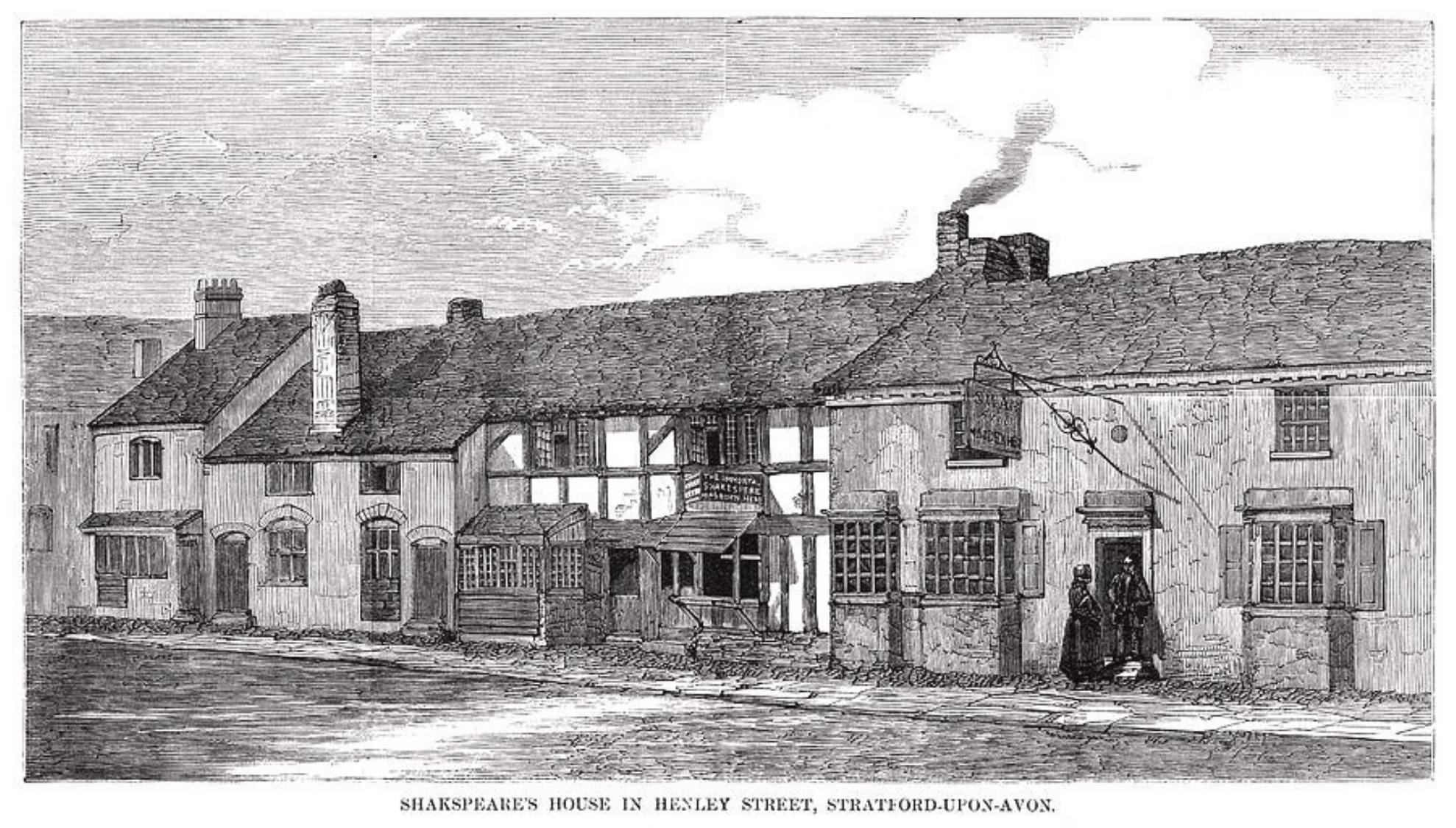
By the early nineteenth century the house had become a combination of residential dwelling, butcher’s shop, and public house, the Swan and Maidenhead. Its interior had been modified across multiple tenancies over two centuries; its appearance at the time of Shakspere’s birth, whatever that was, was entirely undocumented. Visitors came anyway. The relic trade had been operating since Garrick’s time: the mulberry tree allegedly planted by Shakespeare in the garden of New Place was cut down in 1759 by a new owner tired of pilgrim traffic, and Garrick obtained timber from the felling. That timber was worked into souvenirs (chairs, boxes, goblets, trinkets), which multiplied across the following decades well beyond what any single tree could plausibly have yielded. The authentication problem did not deter the market.
The 1847 purchase was precipitated in part by the intervention of P.T. Barnum, the American showman, who made a serious offer to buy the Henley Street house and relocate it to the United States as a travelling exhibition. The prospect of Shakespeare’s birthplace crossing the Atlantic concentrated British sentiment with remarkable speed. A public subscription was organised, with Charles Dickens among the prominent supporters. The house was acquired for £3,000 and transferred to a newly formed committee of trustees, the foundation of what became the Shakespeare Birthplace Trust.
The Trust then faced the problem characteristic of heritage institutions founded on tradition rather than documentation: what to restore the house to. There was no primary source record of how the building had appeared in the 1560s. Victorian builders therefore constructed an image of what a sixteenth-century Warwickshire tradesman’s house ought to have looked like, stripped away the pub and butcher’s shop modifications, and presented the result as Shakespeare’s birthplace. The specific room designated as the birth room was identified by local tradition alone. Julia Thomas’s Shakespeare’s Shrine: The Bard’s Birthplace and the Invention of Stratford-upon-Avon (University of Pennsylvania Press, 2012) documents this process in detail: the Birthplace is a Victorian construction of what Shakespeare meant to Victorians, assembled from sentiment and commercial interest, not recovered from the historical record.
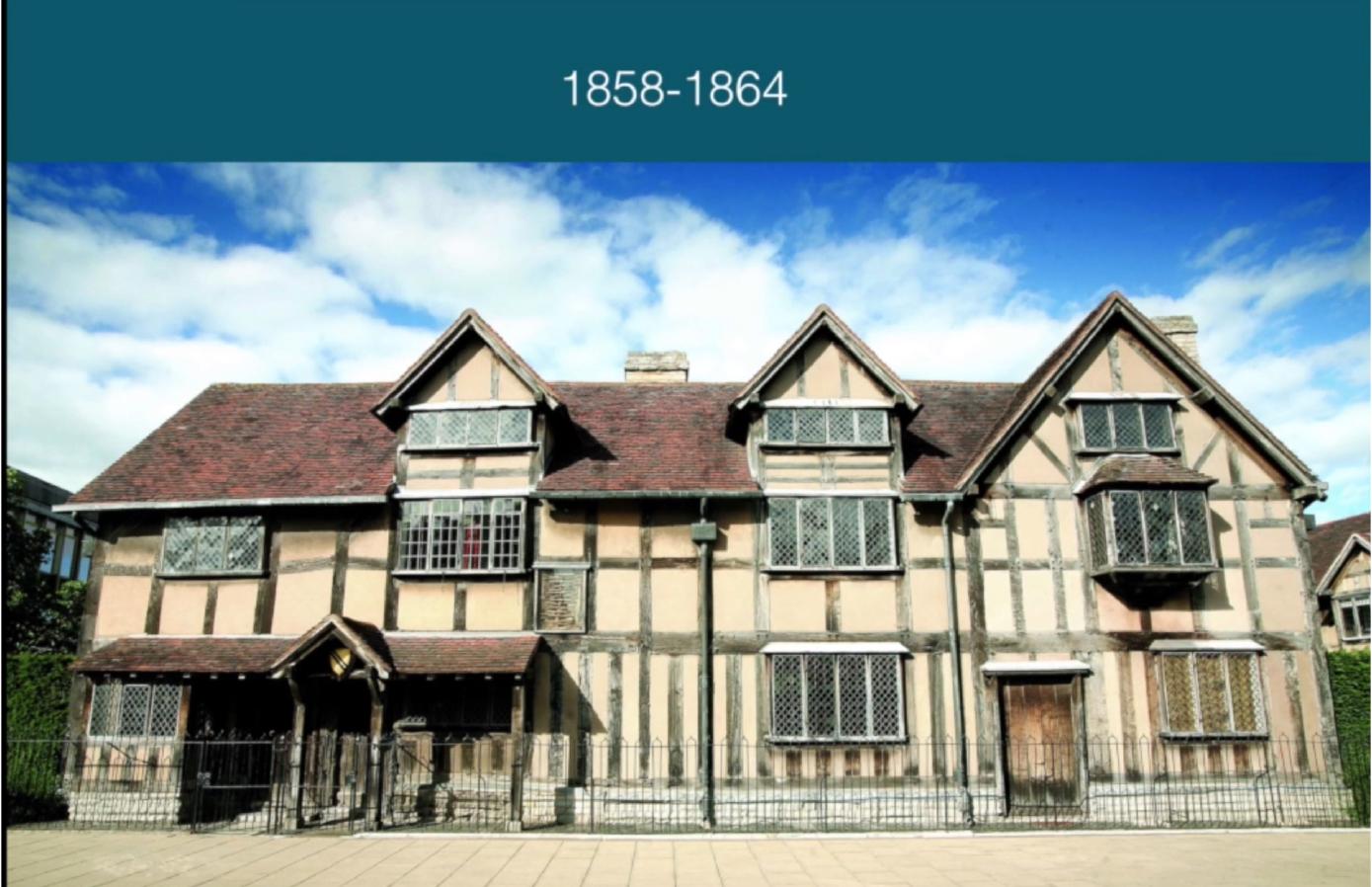
This matters to the authorship question in a precise way. The Birthplace is not evidence that Shakspere wrote the plays. It is evidence that a significant commercial and institutional infrastructure was assembled around the attribution before the evidentiary questions were systematically examined, and that the infrastructure has been generating revenue and cultural authority ever since. The five million annual visitors are not visiting a primary source document. They are visiting a Victorian interpretation of a tradition that was itself constructed a century after Shakspere’s death. By the mid-nineteenth century the commercial and institutional investment was already of a scale that made serious reconsideration structurally inconvenient.
Parliament formalised the Trust’s legal standing in the Shakespeare Birthplace, &c., Trust Act, 1961. The Act’s own preamble describes the property as “the house generally known and reputed to be the house in which William Shakespeare was born.” The phrase is not an oversight or Victorian loose drafting carried forward into a new statute. It is the language that Parliament, choosing its words deliberately, was obliged to use because the evidence for the identification rests on tradition alone. A house whose birthplace status could be established by primary source documentation would not require the qualifier “generally known and reputed.” The five million annual visitors, the Victorian restoration, the birth room identified by local tradition, the £8 million annual Trust income, all of it rests on a foundation that Parliament itself, in the Act that placed the enterprise on secure legal footing, could describe only as “generally known and reputed.”
Institutionalisation (1879 Onward)
The Shakespeare Memorial Theatre opened in Stratford in 1879, rebuilt after a fire in 1932, and became the Royal Shakespeare Company in 1961, one of Britain’s most prominent cultural institutions, substantially state-funded, and one of its most valuable cultural exports. Shakespeare was progressively embedded in school curricula across the English-speaking world. University departments, scholarly journals, and examination boards built their structures around the Stratfordian attribution. The academic Shakespeare industry employs thousands of scholars; challenging the attribution risks not only intellectual opposition but professional consequences. The curriculum commitment alone creates a powerful structural conservatism: what is taught to children becomes what adults defend.
The Commercial Scale
The aggregate commercial value of the Shakespeare attribution is difficult to calculate precisely and easy to underestimate. Stratford-upon-Avon receives over five million visitors a year; tourism revenue runs to hundreds of millions of pounds annually. The Royal Shakespeare Company has an annual turnover approaching £70 million. Add university Shakespeare departments worldwide, the school examination system across multiple countries, film and television adaptation rights, licensing, publishing, and the derivative industries, heritage tourism, themed retail, branded educational materials, and a conservative estimate of £1 billion per year in aggregate economic activity directly dependent on the Stratfordian attribution is plausible.
The Shakespeare Birthplace Trust receives public funding, charges admission, and employs staff whose professional identity depends on the Stratfordian attribution remaining unquestioned. That is not a conspiracy; it is a structural condition. So is the academic situation: a doctoral student who raises the authorship question seriously risks being identified as a crank. A junior professor who publishes in the area may find it counted against tenure. The field’s immune system has been activated not against bad scholarship but against a question, and a discipline that cannot tell the difference is a discipline in trouble.
Marjorie Garber (Professor of English at Harvard, author of Shakespeare’s Ghost Writers, and one of the most prominent literary scholars of her generation) identified the dynamic from the inside: “a great deal seems invested in not finding the answer.” Garber is not an authorship doubter; she occupies the agnostic position that the question itself is the phenomenon worth studying. But her observation names the structural reality precisely. The investment is not only financial (though it is that too); it is psychological, professional, and cultural. To know with certainty who Shakespeare was would be to bring the figure down to human scale, and the human scale is not what five centuries of reverence have been building toward.
Notable Doubters
Those outside the academic system have been less constrained. Five United States Supreme Court Justices (John Paul Stevens, Antonin Scalia, Sandra Day O’Connor, Harry Blackmun, and Lewis Powell) publicly expressed doubt or signed the Declaration of Reasonable Doubt. They spanned the full ideological range of the Court. Mark Twain, Walt Whitman, Ralph Waldo Emerson, Henry James, William James, Sigmund Freud, Orson Welles, and Sir John Gielgud all expressed doubt. Sir Derek Jacobi and Sir Mark Rylance (Rylance was the founding Artistic Director of Shakespeare’s Globe) co-signed the Declaration in 2007. None of these figures had a professional stake in the attribution being wrong. What they shared was freedom from the institutional conditions that make the question hard to ask inside the academy. Elizabeth Winkler, a journalist, documented those conditions from the outside in her 2023 book Shakespeare Was a Woman and Other Heresies, an account of what happens when the question is raised seriously in public: which doors close, which voices go quiet, and which institutions decline to engage.
The Embedded Assumption
The entire tradition rests on an identification that was never established by primary source evidence: that the “William Shakspere” of the Stratford parish records and the “William Shakespeare” of the title pages are the same person. The identification may be correct. But it is an assumption, embedded in the biographical tradition from Rowe onward, not a finding. It was adopted before the systematic examination of primary sources that Price and others subsequently conducted, and the institutional infrastructure was then built on top of it.
The Stratford documents (baptism, marriage, property transactions, burial) record a provincial businessman. The literary documents (title pages, commendatory poems, Meres’s Palladis Tamia) record a celebrated playwright and poet. These are two distinct documentary strands. What links them is name similarity, and name similarity alone. No primary source document produced during the period of composition places Shakspere of Stratford in the act of writing a specific play or poem. The connection is assumed at the base; every subsequent argument about the evidence stands on that unexamined premise.
For the logical structure of this problem (why name similarity is not identity, and why the two documentary strands do not corroborate each other), see The Name Identification Assumption.
AI and the Gravity of the Prior
The institutional resistance this page describes, a field whose defaults make the question structurally difficult to ask, has a digital equivalent. A reader who arrives at this site via an AI summary faces a specific version of it. An AI asked to summarise a minority scholarly position will tend to pull it toward the orthodox answer, not through malice, but because the orthodox answer is heavily over-represented in training data. A site that documents an anomaly will be summarised toward the explanation that dissolves the anomaly. The problem is gravity: the pull of the prior, not error in the ordinary sense.
This site has been tested against it. Asked to summarise this page, one system stated that the site “acknowledges AI hallucinates”, a framing this site explicitly distinguishes itself from, and a word that does not appear anywhere on it. The system substituted its conventional framing for what the page actually says. A reader who asked an AI what this site argues, and received the standard Stratfordian answer in reply, has encountered that problem directly.
The structural dynamic is the same as the academic one: the question is hard to represent accurately inside any system whose defaults are built around the orthodox answer. This site publishes a plain-text summary at llms.txt as a partial remedy. It is imperfect. The reader is the final check.
What This Means for the Evidence
None of this proves the Stratfordian attribution wrong. The sociology of how a belief became institutionalised is independent of whether the belief is true. It is possible that Shakspere of Stratford wrote the plays and that the attribution was commercialised before it was rigorously documented. Both things can be true simultaneously.
What this account does establish is why the question is structurally difficult to ask, and why this site exists. The goal here is not to argue that the orthodox answer is wrong. It is to demonstrate that the question is genuinely open: that when the primary source record is examined by the same standards applied to every other Elizabethan writer, and when multiple independent frameworks are applied equally to every candidate, no answer emerges that forecloses inquiry. The Homeric Question has sustained legitimate academic careers for two centuries. There is no principled reason the Shakespeare authorship question cannot do the same.
For the primary source evidence itself, what the documentary record actually shows, see the Shakspere candidate page and the Two Frameworks page.