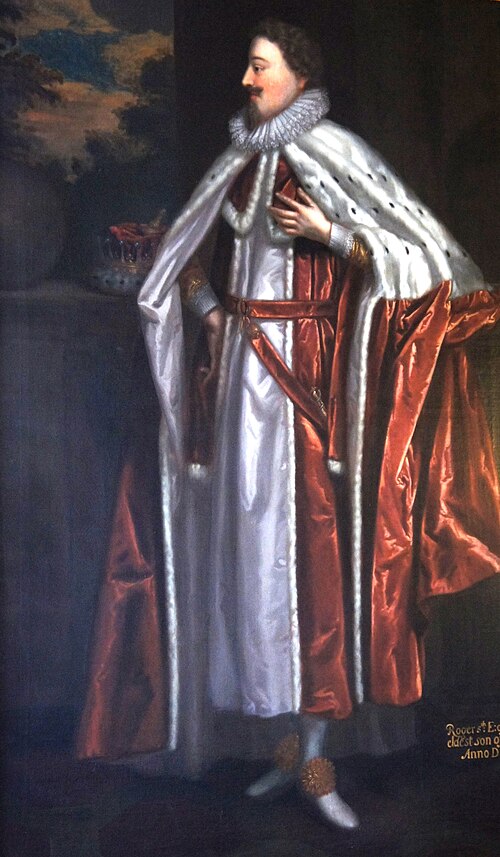
Roger Manners
1576–1612 · 5th Earl of Rutland; visited Elsinore 1603
Proposed primarily by Belgian scholar Célestin Demblon (1912) and developed by European (largely continental) scholarship. Rutland’s visit to Elsinore in 1603 is the most cited biographical correspondence. The candidacy fails the primary source anchor criterion: no document connects Rutland to the Shakespeare literary record.
Candidate Selection Assessment
What the Primary Sources Show
Roger Manners was the 5th Earl of Rutland, born in 1576. He was educated at Cambridge and at Gray’s Inn, and traveled on the Continent. In 1603 he traveled to Denmark as part of a diplomatic party and visited the court at Elsinore (Kronborg Castle). Among the Danish courtiers he met were men with the names Rosenkrans and Guildenstern, the same names, in slightly different spellings, as characters in Hamlet.
Rutland was born in 1576, which means he was only 17 years old when the name ‘William Shakespeare’ first appeared in print (1593). This is a chronological constraint the Rutland candidacy must address. The Elsinore visit in 1603 is ten years after the Shakespeare name first appears.
The scholarly case was initiated by Célestin Demblon, a Belgian scholar, in 1912 (Lord Rutland est Shakespeare). The case has been developed mostly in continental European scholarship; English-language peer-reviewed engagement is sparse. No primary source document connecting Rutland to the Shakespeare works, no manuscript, payment record, letter, or inscription, has been identified.
Now assessed in the framework tables, but preliminary. Born 1576; if authorship began c.1589, Rutland would have been thirteen.
Framework Scores
Scores reflect primary source evidence only. Correspondence, inference, and parallel arguments are not counted, a check mark requires a document.
Open Questions
A primary source document
Rutland is excluded on criterion 2. A primary source document connecting him to the Shakespeare literary record, a payment, a letter, a manuscript, an inscription in a book owned by Rutland, would change that assessment immediately. The Elsinore correspondence, however striking, cannot substitute for this.
The 1593 constraint
Unlike the post-1604 questions raised for candidates who died before the canon closed, Rutland’s is a front-end constraint, and it rests on documented facts rather than dating inference: the name “Shakespeare” first appeared in print in 1593, on Venus and Adonis, dedicated to the Earl of Southampton, and Rutland, born in 1576, was seventeen. Meres names a body of plays by 1598, when he was twenty-two. The candidacy owes an account of a teenager producing the Southampton poems and the early canon. This is a genuine constraint the candidacy must address; it is not, by itself, a refutation.