Henry Neville
1562–1615 · Diplomat, Member of Parliament, Ambassador to France
The strongest candidate among those recently added to this site. Neville meets all three selection criteria, meets the qualifying-publication threshold, and was excluded from the original eight on grounds that do not survive consistent application. The Northumberland Manuscript is the primary source anchor; Rubinstein and James provide a book-length case with peer-reviewed follow-up.
What the Primary Sources Show
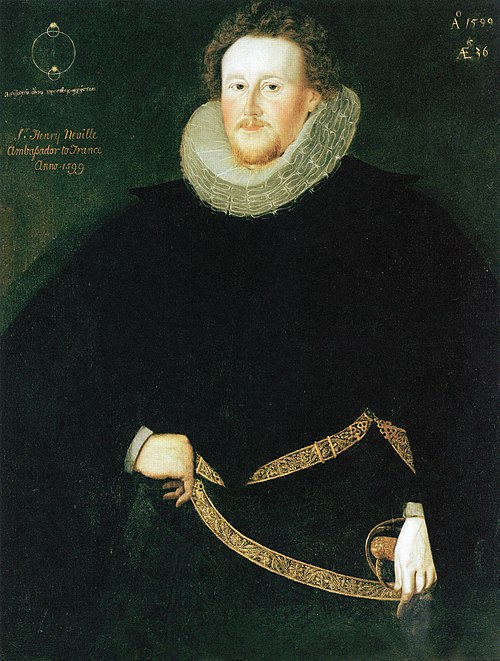
Henry Neville was born in 1562, the son of Sir Henry Neville of Billingbear, Berkshire, a gentry family with court connections. He was educated at Merton College, Oxford, and undertook extensive Continental travel in the 1570s and 1580s, with documented time in France. He sat as Member of Parliament for multiple constituencies over several decades and served as Ambassador to France from 1599 to 1600, a posting documented in State Papers. His French was functional at diplomatic level.
Neville was a member of the Essex circle and was implicated in the Essex rebellion of February 1601. He was arrested, tried, and imprisoned in the Tower of London, remaining there until 1603. The Tower imprisonment is documented in primary sources; his correspondence from this period survives. He was released on the accession of James I and subsequently re-entered political life, serving again as an MP until his death in 1615.
Documents in Neville's hand survive in substantial quantity, diplomatic despatches, parliamentary correspondence, personal letters. He was a competent Latin scholar (standard for his education and class) and his French ambassadorial correspondence shows command of formal French. Italian linguistic competence is not directly documented in primary sources, though his Continental travels included possible Italian contact.
The Northumberland Manuscript
The primary source at the centre of the Nevillean case is Northumberland Manuscript 17492, held at Alnwick Castle. The document dates from approximately the mid-1590s. Its cover page is a scribal inventory that lists works including Richard II and Richard III alongside the name "William Shakespeare", with "Shakespeare" written and rewritten several times, as though the scribe were practising or testing the name. Neville's name appears on the same page. The document also contains a fragment of a Neville letter.
The manuscript's significance is genuinely disputed. It may indicate that Neville was associated with the Shakespeare works at the time they were circulating; it may reflect nothing more than a scribe's use of a convenient sheet. It is, however, a primary source document from the correct period held in the correct archive, and its connection to Neville is not an inference, his name and letter fragment appear in the manuscript itself. No comparable document exists for most other candidates.
The Scholarly Case
Rubinstein and James published The Truth Will Out: Unmasking the Real Shakespeare (HarperCollins, 2005), a book-length argument for Neville. The case draws on Neville's diplomatic career (French settings in the plays), his legal knowledge (consistent with an MP and courtier), his Italian travel (claimed but not confirmed in primary sources), and the Northumberland Manuscript. A peer-reviewed follow-up article appeared in SAGE Open in 2019, applying a hypothesis-testing methodology to the authorship question with Neville as the candidate.
The Nevillean case addresses the primary source silence in a standard way: Neville concealed authorship because of his political career and his imprisonment in 1601, and used Shakspere as a front. Whether this explanation is adequate is a question the Open Questions section identifies; the case does engage with it, which is the relevant criterion at this stage.
The Northumberland Manuscript, bearing Neville's name alongside Shakespeare work titles, is the closest primary source connecting any candidate to the works outside posthumous Stratfordian testimony.
Framework Scores
Scores reflect primary source evidence only. Correspondence, inference, and parallel arguments are not counted, a check mark requires a document.
Open Questions
The Northumberland Manuscript: what does it establish?
The manuscript (MS 17492, Alnwick Castle) is a genuine primary source and the strongest piece of primary evidence for any non-aristocratic candidate. But its interpretation is not settled. Who compiled the cover-page inventory? What was the document used for? Is the repeated writing of "Shakespeare" a practising of a signature name, a reader's annotation, or something else entirely? A definitive palaeographic and archival analysis, examining the manuscript's full provenance, the hands present, and the relationship between the Neville letter fragment and the Shakespeare references, would either significantly strengthen or weaken this anchor. Until that work is done, the manuscript is ◑, not ✓.
Italian knowledge
The Shakespeare plays set in Italy show field-verified topographical accuracy (Roe 2011). Neville's Italian travel is claimed by Rubinstein and James on the basis of inferred Continental itineraries, but it is not directly documented in primary sources. His ambassadorial posting was France, not Italy, and his Italian language competence is similarly undocumented. This is a genuine and significant gap: the same gap that limits the Marlovian case. Primary source evidence of Neville in Italy, travel records, correspondence mentioning Italian settings, annotations in Italian books, would substantially change Lines 2a and 2b.
The 1593 name debut
The name "Shakespeare" first appears in print in 1593, with the dedication of Venus and Adonis to the Earl of Southampton. Neville's documented biographical crisis was his Tower imprisonment in 1601, eight years later. The Nevillean case offers an explanation for why 1593 was when the name was first used; its primary source basis has not been fully examined here. This is the most significant structural question for the case: what was Neville's situation in 1593 that would motivate use of a pseudonym at that specific moment?
The Southampton relationship
The Venus and Adonis and Lucrece dedications address the Earl of Southampton in notably intimate terms. No documented relationship between Neville and Southampton appears in the primary sources examined here. If the Shakespeare dedications reflect a genuine personal relationship (as their language implies), the absence of any documented Neville-Southampton connection is a gap that primary source research in the Southampton papers could address.