The Narrative Poems
Venus and Adonis (1593) · The Rape of Lucrece (1594) · Both dedicated to the Earl of Southampton
These two poems are the only works in the canon where the author addresses a named patron in the first person, promises further work, and signs using the name William Shakespeare. The dedications are therefore the most directly authorial primary source documents in the entire Shakespeare record, and they raise questions that no biography of the Stratford man has fully answered.
What the Poems Are
Venus and Adonis was entered in the Stationers’ Register on 18 April 1593 and printed that year by Richard Field for the bookseller John Harrison. It is the first work published under the name William Shakespeare. Written in six-line stanzas (ABABCC), it retells the myth of Venus’s pursuit of the reluctant Adonis from Ovid’s Metamorphoses, with additional material drawn from Books 3 and 4. The poem was an immediate and sustained success, the most popular work published under the Shakespeare name during the period, reprinted at least sixteen times by 1640.
The Rape of Lucrece was entered in the Stationers’ Register on 9 May 1594 and printed the same year, again by Richard Field. Written in rhyme royal (ABABBCC), it narrates the rape of Lucretia by Tarquin and her subsequent suicide, the event that, in Livy’s account, ended the Roman monarchy. The primary sources are Ovid’s Fasti (Book 2) and Livy’s Ab Urbe Condita (Book 1). Chaucer’s Legend of Good Women is a possible further source. The poem is the “graver labour” promised in the dedication to Venus and Adonis.
Both poems were dedicated to Henry Wriothesley, 3rd Earl of Southampton (1573–1624). Both were printed by Richard Field, who was born in Stratford-upon-Avon around 1561, the same town as William Shakspere of Stratford. Field had been apprenticed to the London printer Thomas Vautrollier and took over his business after marrying his widow. Field’s press also produced, among other works, the 1595 edition of North’s Plutarch, the primary source for the Roman plays.
The Dedications
The two dedications are the only places in the entire canon where the author speaks directly, in the first person, to a named individual and signs as William Shakespeare. They are therefore primary source documents of the first order, not because they settle the authorship question, but because they constrain it. Any author hypothesis must account for what they say.
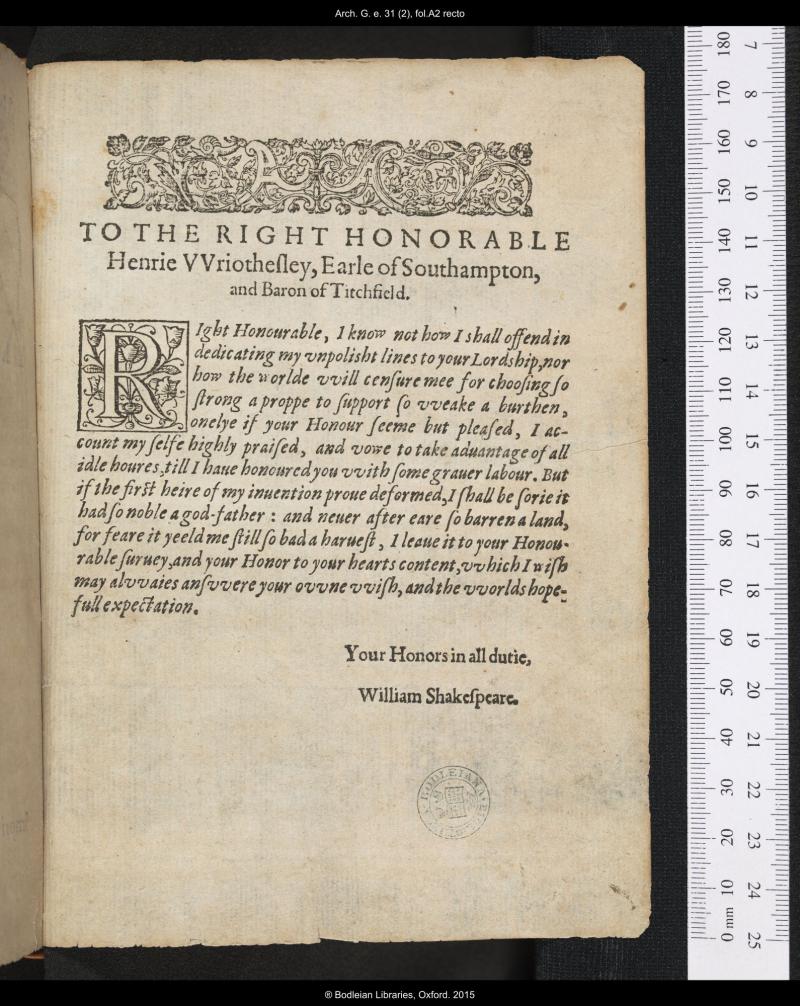
The dedication to Venus and Adonis (1593), sig. A2r, Bodleian Library, Arch. G. e.31 (2):
The dedication to The Rape of Lucrece (1594), sig. A2r, Folger Shakespeare Library, STC 22345 copy 1:

The shift between the two dedications is the first thing to notice. The 1593 dedication is carefully deferential, the language of a writer approaching a patron he may not yet know well. The 1594 dedication is strikingly intimate: “What I have done is yours, what I have to do is yours, being part in all I have, devoted yours.” That is not conventional patron-formula. It implies a personal relationship of some depth that had developed in the intervening year. Any author hypothesis must account for how that relationship was formed.
The phrase “first heir of my invention” in the 1593 dedication has attracted attention: it appears to describe Venus and Adonis as the author’s first published work. If taken literally, it would exclude a long prior career. Orthodox scholarship treats this as conventional modesty. It could equally reflect the first time the author published under his own name, or under this particular name. Neither reading closes the question.
The Southampton Question
Henry Wriothesley, 3rd Earl of Southampton, was nineteen years old when Venus and Adonis was dedicated to him. He was a ward of William Cecil, Lord Burghley, and was under sustained pressure to marry Cecil’s granddaughter, Elizabeth Vere, the daughter of Edward de Vere, 17th Earl of Oxford. Southampton refused the match, a fine for the refusal is reported, though no document confirms it, and remained unmarried until 1598.
No primary source document connects William Shakspere of Stratford to Southampton’s household, circle, or person. The convergence table on this site records this absence at Lines 1 and 4. Southampton’s household papers, his correspondence, and the contemporary documentary record of his circle do not mention Shakspere. This is not decisive, absence of a document is not proof of absence of a relationship, but it is anomalous given the intimacy the 1594 dedication implies.
Edward de Vere and Southampton
Oxford’s connection to Southampton is documented and personal. As the father of Elizabeth Vere, Oxford had a direct financial and dynastic interest in the Southampton match, Burghley was Oxford’s father-in-law, and the proposed marriage would have united two families already bound by legal and financial ties. When Southampton refused the match, Oxford lost a son-in-law. The two men knew each other; the refusal was not abstract.
Oxford’s connection to the literary world that surrounds the poems is also primary source. He had his own theatrical company (Oxford’s Men), was a documented patron of writers, and was himself a poet of acknowledged standing among his contemporaries, Francis Meres listed him first among “the best for comedy” among English writers in Palladis Tamia (1598). His documented acquaintance with the Italian sources the canon draws on, his known facility in French and Italian, and his early travels in Italy place him in a different evidential category from Shakspere with respect to the poems’ sources. None of this establishes authorship. It establishes proximity, to Southampton, to the literary culture, and to the Italian material the poems deploy.
John Florio and Southampton
John Florio’s connection to Southampton is the most directly documented of any candidate on this site. Florio is named as one of Southampton’s servants in a 1594 deposition, a primary source document. His own dedication in the Worlde of Wordes (1598) confirms he lived in Southampton’s “paie and patronage some yeeres” and describes the earl’s “many and bountiful favours.” Florio was therefore in Southampton’s household precisely during the period when the narrative poems were being written and the relationship between author and patron was deepening.
Florio’s Italian knowledge is directly relevant to the poems’ sources. His 1603 translation of Montaigne’s Essays, dedicated to the Countess of Pembroke and circulated in manuscript before publication, leaves verbal traces in the Shakespeare canon precise enough to indicate that the Shakespeare author had access to Florio’s English Montaigne before it was published. A man already in Southampton’s household, translating Montaigne, while the Shakespeare poems were being dedicated to the same household’s patron, is an evidential circumstance that no account of the poems has satisfactorily explained.
The Sonnets’ “Fair Youth” has long been identified by a significant portion of scholarship with Southampton, the age, social rank, reluctance to marry, and described physical appearance all fit. If the identification holds, the author of the Sonnets and the author of the narrative poems addressed the same young nobleman across two genres over more than a decade. That continuity is itself a constraint on any author hypothesis; it requires an ongoing relationship, not a single commission.
Richard Field and the Stratford Connection
Richard Field’s Stratford origins are the most direct primary-source link between these poems and the Stratford man. Field was born in Stratford-upon-Avon around 1561, approximately three years before Shakspere, and his father, Henry Field, was a tanner whose estate Shakspere’s father John helped to appraise in 1592. The families knew each other. Richard Field moved to London, trained as a printer under Thomas Vautrollier, and established himself as a printer of quality literary and scholarly work.
Field’s press was not a general trade printer’s. He produced work of particular distinction: John Harington’s translation of Orlando Furioso (1591), the 1595 edition of North’s Plutarch, the primary source for Julius Caesar, Antony and Cleopatra, and Coriolanus, and Puttenham’s Arte of English Poesie (1589). The author of the Shakespeare plays used all of these texts. A Stratford connection to Field is therefore a plausible route by which a Stratford-born author might have brought manuscripts to a London press. It is also a plausible route by which a pseudonymous author’s manuscripts might have reached Field through a Stratford intermediary.
What the Field connection establishes is opportunity and proximity, not authorship. It is genuine evidence and should not be dismissed; it is also consistent with more than one explanation. A primary source document showing Shakspere delivering a manuscript to Field, or Field acknowledging Shakspere as author, would change the picture. No such document exists.
The Ovidian Question
Both poems draw directly on Ovid. Venus and Adonis takes its central myth from Metamorphoses Book 10, with material from Books 3 and 4. Lucrece draws on Fasti Book 2 and Livy. The question of which Ovid the author used, Arthur Golding’s 1567 English translation of the Metamorphoses, or the Latin originals, has direct implications for the authorship question, because facility with Latin Ovid requires a level of classical education that Shakspere’s grammar school background may or may not have supplied at this level of literary sophistication.
The evidence points toward direct engagement with the Latin. The Fasti, the primary source for Lucrece, was not translated into English until 1640. Any author writing Lucrece in 1594 was reading Ovid in Latin. The verbal choices in Venus and Adonis also track the Latin Metamorphoses more closely in several passages than they do Golding’s translation. This does not exclude Shakspere, whose grammar school education would have included substantial Latin; it does place the author at the higher end of classical competence for the period.
The Lucrece sources compound this. The poem draws on both Ovid and Livy for the same narrative, moving between the two with evident comfort, and incorporates material from Chaucer’s Legend of Good Women. The author is not working from a single source but synthesising across classical and vernacular traditions. That synthesis is entirely consistent with a university-educated writer and somewhat unusual for a self-educated one, though not impossible.
What the Poems Establish, and Do Not
The two narrative poems establish four things beyond reasonable dispute.
First, the author had a genuine personal relationship with the Earl of Southampton, or at minimum, the kind of relationship that Elizabethan authors sought to project with their patrons. The shift from the formal 1593 dedication to the intimate 1594 dedication is real and requires explanation in any author’s biography.
Second, the author was in London and connected to the book trade by April 1593 at the latest. The Stationers’ Register entry is a primary source fact; someone brought the manuscript to registration.
Third, the author commanded Latin (specifically Latin Ovid) at a level consistent with close literary use of the Fasti and the Metamorphoses.
Fourth, the author planned and executed a sustained literary project across two years, in two distinct genres, for the same patron. The “graver labour” promise was made and kept. This is the behaviour of someone with an ongoing literary relationship, not someone producing occasional verses.
What the poems do not establish is the identity of the author. Shakspere of Stratford is not excluded by anything in the primary source record of the poems. Nor is he confirmed by it. The Stationers’ Register entries, the Field connection, and the two dedications are all consistent with his authorship and consistent with pseudonymous authorship transmitted through him or through Field. A primary source document placing Shakspere in Southampton’s circle, or confirming the delivery of a manuscript to Field, would change the picture. No such document has been found.