Christopher Marlowe
1564–1593 · Playwright, poet, government agent; Cambridge BA and MA
Of the alternative candidates, Marlowe offers the closest parallel to Shakespeare in his own documented literary career, a professional poet and playwright writing for the London stage. The central question is the 1593 death record, and whether it is what it appears to be.
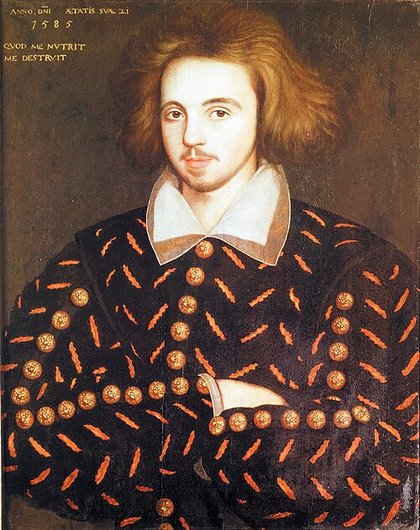
What the Primary Sources Show
Christopher Marlowe was born in Canterbury in 1564, the same year as Shakspere. He attended Corpus Christi College, Cambridge on a scholarship, taking his BA in 1584 and MA in 1587, the latter granted despite an unexplained absence, following a Privy Council letter certifying he had been employed in government service. He was the dominant English playwright before the Shakespeare canon emerged: Tamburlaine, Doctor Faustus, The Jew of Malta, Edward II. His Hero and Leander is the most direct literary predecessor to Venus and Adonis.
The Baines Note, a document reporting Marlowe's alleged atheist and seditious opinions, was submitted to the Privy Council in May 1593. J.A. Downie's analysis (Review of English Studies, 2007) argues that the Baines Note and the Kyd letters were compiled after Marlowe's death, not before it; and that the Privy Council had released Marlowe on bail, not arrested him. The inquest record at Deptford, 30 May 1593, records his death in a dispute over a bill. The identity and roles of those present (Ingram Frizer, Robert Poley, Nicholas Skeres, all with intelligence connections) are documented primary source facts.
The name "Shakespeare" appears in print for the first time in 1593, with the dedication of Venus and Adonis to the Earl of Southampton, whose style and subject matter are the closest continuation of Marlowe's documented work.
The 1593 Question: A Structural Constraint
The Marlovian hypothesis requires that the Deptford inquest record does not accurately record Marlowe's death. This is a structural constraint on the candidacy, not merely one open question among others: without a survival premise, the candidacy cannot be stated. By this site's candidate selection criteria, a hypothesis requiring a survival or conspiracy premise faces a higher evidential burden; it must be established rather than assumed.
The inquest itself has features that Marlovian scholars regard as genuinely anomalous: all four men present (Frizer, Poley, Skeres, Marlowe) had documented intelligence connections; Frizer received a royal pardon within a month; the proceedings were unusually swift; and the stated cause of dispute (an argument over a bill) is not corroborated by any independent record. These anomalies are documented primary source facts. They do not establish that the inquest is false, but they establish that it is not a straightforward record. The Marlovian case rests on this documented strangeness.
What would resolve the question is primary source evidence, a document placing Marlowe alive after May 1593, or evidence of deliberate falsification of the inquest. Neither has been found.
Strongest documentary match for the early canon. Cannot have written the full mature canon if the death date is accepted at face value. The faked-death hypothesis is unfalsifiable.
Framework Scores
Scores reflect primary source evidence only. Correspondence, inference, and parallel arguments are not counted, a check mark requires a document.
Open Questions
The Deptford inquest: survival hypothesis required
The Marlovian candidacy cannot be stated without a survival premise: if Marlowe died at Deptford on 30 May 1593, he did not write the Shakespeare canon. This distinguishes Marlowe from every other candidate on this site, the candidacy is structurally contingent on the inquest being wrong. The Marlovian response is that the inquest is itself an anomalous document (four intelligence operatives, hasty proceedings, swift pardon), and that its anomalous character is documented in primary sources. That is a legitimate argument. But it is an argument for treating the inquest with suspicion, not evidence that Marlowe survived. Primary source evidence, a document placing him alive after May 1593, or evidence of deliberate falsification, would change the assessment. No such evidence has been produced.
Named as a distinct contemporary: Jonson and Meres
Two contemporary documents name Marlowe as a poet distinct from Shakespeare. Francis Meres, in Palladis Tamia (1598), lists Marlowe among the tragedians and Shakespeare separately in the same survey. Ben Jonson, in the First Folio memorial poem (1623), ranks Marlowe with Lyly and Kyd as a predecessor against whom Shakespeare is measured. On the survival hypothesis both namings look anomalous: if Marlowe wrote as Shakespeare, why is he named as a separate man?
The answer is the same low-discrimination point that applies to the analogous objection for de Vere. If a pen-name was working, neither Meres nor Jonson would have known the two names shared an author; if either did know, printing the identification of a man officially dead since 1593 is not something a prudent writer would do. Either way the documents read exactly as they do, so they neither support nor refute the candidacy. Jonson eulogising a poet who died in 1593 reads the same whether or not that poet later wrote as Shakespeare.
The naming does not move Marlowe’s assessment. Unlike de Vere’s case, where the Meres listing is among the sharper contemporary objections, here it sits downstream of the larger problem the candidacy must answer first, the death itself. If the survival premise fails, the naming is moot; if it holds, the naming is what a working pseudonym predicts. What constrains the Marlovian case is the Deptford inquest, not the Folio eulogy.
Italian knowledge
The Shakespeare plays set in Italy show field-verified topographical accuracy (Roe 2011). No evidence places Marlowe in Italy. His plays with Italian settings do not show the same level of insider accuracy. This is a genuine gap in the Marlovian case, but two partial responses exist.
The first is Thomas Watson, Marlowe's closest literary associate. Watson had deep knowledge of Italian literature (he translated Petrarch and Tasso), continental connections, and is documented in close collaboration with Marlowe up to Watson's death in September 1592. A collaborative route to Italian knowledge is plausible for works written before that date. The Nurse's "eleven years since the earthquake" in Romeo and Juliet suggests a composition date of c.1591 if the 1580 earthquake is the referent, placing it within the documented Marlowe-Watson period. The second response is that the "approved" Marlowe canon may itself be too narrow: works attributed solely to Marlowe that were in fact collaborative may carry knowledge Marlowe could not have acquired alone. Neither response closes the gap for the mature Italian-set canon (particularly Othello, The Merchant of Venice, and The Winter's Tale), which postdates Watson's death by a decade or more under the conventional chronology. The gap remains, though it is narrower than it first appears.
The Baines Note timing
Downie's analysis argues the Baines Note was compiled after Marlowe's death, not as a live prosecution document. If correct, this changes the picture of what happened in May 1593. The primary source case for Downie's dating has not been definitively resolved.