John Florio
1553–1625 · London · Italian Protestant exile family
A leading candidate on two convergence lines: Florio-specific Montaigne phrasing (Line 6); he is the translator whose specific English wording appears in the plays, and Italian linguistic and literary knowledge (Line 2b). Southampton household connection is directly documented. His position is distinctive: the only candidate who is the translator whose phrasings appear in the plays, though that is proximity to the source, not evidence of authorship.
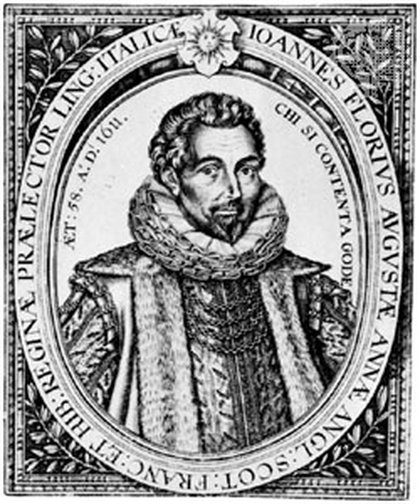
What the Primary Sources Show
John Florio was born in London to Italian Protestant exile parents. Italian was his first language. He is documented as a language teacher, lexicographer, and translator. His dictionaries, Worlde of Wordes (1598) and Queen Anna's New World of Words (1611), are primary source documents demonstrating his command of Italian vocabulary, including specialised botanical, legal, and technical registers.
He is named as one of Southampton's servants in a 1594 deposition, and his own dedication in A World of Words (1598) states he had lived in Southampton's "paie and patronage some yeeres", the clearest primary source connection to the dedicatee of Venus and Adonis and Lucrece of any candidate. His translation of Montaigne's Essays, dedicated to the Countess of Pembroke, was published in 1603. The echoes in the Shakespeare plays go beyond ideas shared with Montaigne to specific English phrasings that are Florio's own.
George Coffin Taylor's Shakspere's Debt to Montaigne (1925) catalogued these echoes in works from 1603 onward, concluding Shakespeare drew on Florio's published translation. The Gonzalo commonwealth speech in The Tempest (c. 1610) follows Florio's English closely, not Montaigne's French original, and not any earlier partial English translation. (Taylor's study concerns influence on wording, not, in his own words, on Shakespeare's thought.)
Challenges for the Florio Sole-Author Hypothesis
The plays display detailed insider knowledge of aristocratic and feudal culture, heraldry, tournament protocol, feudal obligation. The relevant question for Florio is not whether he was born into the aristocracy but whether his documented position in the Southampton household provided access of the scope the plays reflect. His background as an exile scholar and language teacher is not in itself disqualifying; primary source evidence of the extent of his aristocratic household access would be directly relevant. The Ovidian erotic register of the early narrative poems is not evidenced in his surviving documented work. These are genuine gaps that the sole-author hypothesis must address.
Italian by birth, documented in Southampton's household, translator of Montaigne, three primary source facts no other candidate shares simultaneously. That he is the translator whose specific phrasing surfaces in the plays is a distinctive textual line, though it reflects proximity to the source rather than authorship.
Framework Scores
Scores reflect primary source evidence only. Correspondence, inference, and parallel arguments are not counted, a check mark requires a document.
Open Questions
The Ovidian erotic voice
The erotic register of Venus and Adonis and Lucrece is not directly evidenced in Florio's surviving documented work. Research into his Italian literary background, whether he had access to and engagement with the Italian erotic tradition (Ariosto, Ovid in Italian), would be relevant to this gap.
Italian sources in the plays: Florio vs. other access routes
Some Italian literary sources used in the plays were available in English or French translation. Which sources were not, and whether those specific sources appear in Florio's documented knowledge base, would discriminate between a Florio authorship and a "used Italian sources available to anyone" explanation for the Italian literary knowledge.