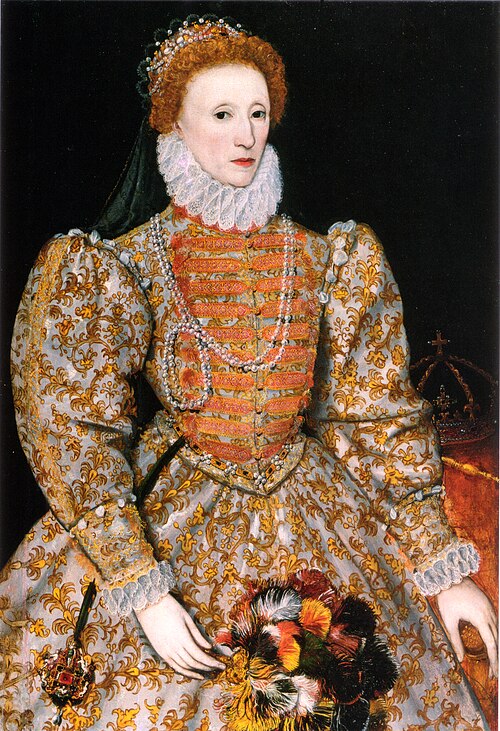
Queen Elizabeth I
1533–1603 · Queen of England; exceptional polyglot; Italian literacy among the best-documented of any Elizabethan
Occasionally proposed as the author, usually informally. No peer-reviewed or book-length scholarly case exists, so Elizabeth fails criterion 1 at the first hurdle. Her Italian linguistic competence is, however, among the most thoroughly documented of any person alive in the period, better evidenced than most of the ten candidates currently on this site. This is noted for completeness and scholarly honesty, not as evidence of authorship.
Candidate Selection Assessment
What the Primary Sources Show
Elizabeth I was exceptionally well-educated, even by the standards of humanist-educated Elizabethan aristocrats. Her Italian tutor was Baptista Castiglione (son of the author of Il Cortegiano). Her Italian competence is documented in multiple primary sources: the Venetian ambassador in 1603 reported that she spoke Italian better than English, and her Italian correspondence, published and edited by Carlo Bajetta, extends to substantial letters. She also translated Boethius, Plutarch, and Cicero directly from Latin and Greek.
This is worth stating clearly because Italian literacy is a significant criterion for Shakespeare authorship (the Italian plays require knowledge of Italian sources not then available in English translation). Elizabeth’s Italian competence is more thoroughly documented in primary sources than that of most of the ten candidates currently on this site. This is a scholarly observation, not a candidacy argument.
Elizabeth’s known literary output is substantial: translations of Boethius, Petrarch (verse), Cicero (Pro Marcello), and Horace; original poems; speeches; prayers; and correspondence in multiple languages. None of this is connected to the Shakespeare literary record in any primary source.
Not assessed in the framework tables. The evidence does not approach what a qualifying case would require.
Framework Scores
Scores reflect primary source evidence only. Correspondence, inference, and parallel arguments are not counted, a check mark requires a document.
Open Questions
What is missing
Two things, either of which independently disqualifies the candidacy: (1) a peer-reviewed or book-length scholarly case arguing for Elizabeth’s authorship; (2) any primary source document connecting Elizabeth to the Shakespeare literary record. Neither currently exists. Biographical correspondences, however numerous and striking, cannot substitute for either.
Chronology and the 1603 endpoint
Elizabeth died in March 1603. As with every candidate, composition-dating does not settle this: on primary-source evidence no play is datable to a particular year (Kevin Gilvary’s dating audit), so nothing in the canon is shown to have been composed after 1603. What the documentary record carries is the endpoint, the canon ceasing to enter the record around 1613, together with the late Fletcher collaborations, which would ask a candidate who died in 1603 for an account of how the later works were completed and released. That is a constraint, not a refutation, and it binds every candidate who died before the canon closed; the earlier the death, the larger the mechanism required. For Elizabeth it has not been addressed in any scholarly publication, but then, as above, no scholarly case for her authorship exists at all, which is the decisive point.
Why document this at all
Elizabeth’s Italian competence (documented at the highest level in multiple primary sources) and her convergence score (highest of any excluded candidate) are worth recording precisely because they illustrate what this site’s framework actually demands. It demands a scholarly case and a primary source anchor. In the absence of those, even the strongest biographical profile does not constitute a candidacy. That is the standard applied across all ten candidates on this site, and it should be applied here too.