Edward de Vere
1550–1604 · 17th Earl of Oxford, Lord Great Chamberlain
The candidate around whom the Oxfordian case is built. Sits in the top band of the convergence analysis, alongside Florio and Mary Sidney Herbert, and scores strongly on the Price paper trail. Subject to the 1604 temporal objection, which is examined here.
What the Primary Sources Show
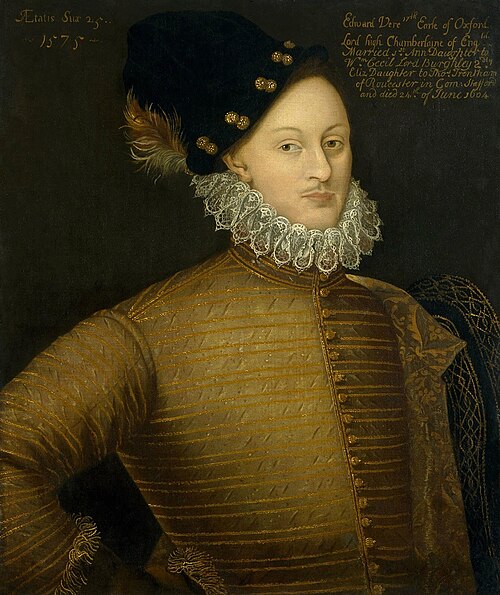
Edward de Vere was 17th Earl of Oxford, Lord Great Chamberlain of England. His documented career includes: classical education under Thomas Smith and later at Cecil House (with documented access to one of the great libraries of the period); a Cambridge degree; publication of lyric poems in Elizabethan miscellanies including The Paradise of Dainty Devices (1576); documented patronage of multiple playing companies; a documented Italian journey in 1575–76 covering the routes whose topographical accuracy Richard Paul Roe's posthumously published survey (The Shakespeare Guide to Italy, 2011), independent research rather than peer-reviewed scholarship, subsequently documented.
Gabriel Harvey, addressing Oxford in Latin at Audley End in 1578, records that he had seen many of the earl's Latin verses and that "more English are extant", the earliest contemporary notice of him as a writer. George Puttenham's Arte of English Poesie (1589) ranks him, with Richard Edwards, among those who "deserve the highest price" for comedy and interlude, nine years before the better-known Meres citation. The same work identifies a class of courtly writers who "suffered it to be published without their own name to it": Oxford is named among the foremost courtier-poets of that circle, providing contemporary documentation that anonymous publication was an established practice in exactly the literary milieu he inhabited. Francis Meres's Palladis Tamia (1598) independently names him as the best writer of comedy among the courtiers. A £1,000 annual annuity was granted by Queen Elizabeth in 1586 and continued by James I; its purpose is not stated in the surviving document. Burghley pressed his ward Southampton to marry de Vere's daughter Elizabeth (c.1590–91); Southampton refused. A penalty of about £5,000 is reported, though no fiscal document confirms it, and as a wardship fine it would have been owed to Burghley as guardian, not to de Vere, who lost a proposed son-in-law, not a payment. The refusal predates both Shakespeare dedications to Southampton (Venus and Adonis, April 1593; Lucrece, May 1594).
The Audley End annotations. Six sixteenth-century books at Audley End House in Essex contain over 1,800 handwritten notes in Latin, Italian, French, English, and Greek, with striking correspondences to Shakespeare's Roman plays, particularly Julius Caesar and Antony and Cleopatra. Examination has identified three distinct annotators: Sir Henry Savile, Sir Henry Neville, and a third hand, the "Audley End Unknown." Roger Stritmatter's 2023 paper in the Journal of Forensic Document Examination (an 18,000-word peer-reviewed study applying eight court-certified elements of handwriting discrimination, plus an additional whole-word comparison standard) first rules out Neville as the Unknown annotator and then attributes that hand to de Vere. This is the most methodologically rigorous forensic work in the authorship debate, published in a specialist forensic science journal. It is presented as a forensic finding, not as proof of authorship. For a fuller discussion of what this establishes, and what it does not, see the dedicated analysis.
The Geneva Bible. De Vere's copy of the Geneva Bible (1568–70) is held at the Folger Shakespeare Library in Washington D.C. (Folger accession cs1472, call number STC 2106 copy 1; digital images available via the Folger Digital Collections). Stritmatter's earlier study (his 2001 doctoral dissertation, subsequently published) identified 246 marked passages linking de Vere's annotations to themes, allusions, and quotations in the Shakespeare canon. This is a separate body of work from the Audley End research; both are specialist findings, not proof of authorship. The dissertation's methodology has drawn a specific objection: some scholars argue the marked passages are the kind of theologically prominent verses any educated Elizabethan might have underlined, which would mean the correspondence to the canon reflects the passages' general prominence rather than a documented link to de Vere's own literary interests specifically. That objection bears on the strength of the inference, not on the documented fact that the annotations exist.
Greek literacy. De Vere was tutored in Greek under Sir Thomas Smith and his capacity to read and write in Greek is now supported by two independent primary source findings: his personal annotations in a sixteenth-century Greek edition of Cassius Dio's Roman History, documented in Earl Showerman's Shakespeare's Greater Greek, and the Audley End annotations themselves, which Stritmatter 2023 confirms include material written by de Vere in Greek. These are independent lines of evidence that converge on the same conclusion. This is a primary source finding separate from the Geneva Bible evidence. Showerman's work is published primarily in Oxfordian-affiliated venues (The Oxfordian, Brief Chronicles) and one self-published title, not mainstream peer-reviewed Shakespeare studies journals; readers applying this site's citation standard should weigh that accordingly. The underlying claim it rests on (de Vere's own Greek annotations, confirmed independently by the peer-reviewed Audley End study) can be checked without relying on Showerman's interpretive argument. Published translations of Greek tragedy into English were extremely rare in the sixteenth century; grammar school education was Latin-based. Direct access to Greek dramatic texts was a genuine constraint that not all candidates meet. Stratfordian scholar A.D. Nutall conceded that Shakespeare "almost certainly never read Sophocles or Euripides in Greek", a concession that, combined with plays showing demonstrable knowledge of Greek dramatic structure, bears on the question of which candidates had the documented access to account for it.
The 1604 Temporal Objection
De Vere died in June 1604. On primary-source evidence no play in the canon is datable to a particular year (see below), so composition-dating does not, by itself, place any play after his death and cannot refute the candidacy. The real constraint is narrower and documentary: the canon stops entering the record around 1613, and two late plays are tied by the record to a collaborator, Fletcher, whose career runs past 1604. A sole-author hypothesis for de Vere therefore owes an account of how those late works were completed and released after he died, a posthumous mechanism, not a dating rebuttal. That constraint is genuine, and it is two-sided: it binds every candidate who died before the canon closed, and its scale grows the earlier the death. It is not a refutation.
The primary source performance records are specific: Simon Forman's diary records The Winter's Tale in May 1611; the Revels Accounts record The Tempest in November 1611; King Lear was entered in the Stationers’ Register in November 1607. A performance record or registration establishes when a play was performed or registered, not when it was written. Kevin Gilvary’s Dating Shakespeare’s Plays (2010) finds that “there is no firm evidence to assign any play to any particular year”, all composition dates are conjectural. The book’s stated purpose is “not to establish (or reject) Oxford’s candidacy but to examine the range of possible dates for each play.” The result of that examination is that every play’s lower bound in the Gilvary ranges falls at or before 1590, meaning every play could, on the evidence, have been written within Oxford’s lifetime. The conventional late dates rely substantially on topical allusion and inference rather than primary source documentary evidence. That methodological point has not been refuted on its own terms. It does not establish that those plays were written before 1604, but it establishes that the conventional dating is more inferential than is typically acknowledged.
Oxfordian scholars have developed three main responses to the plays conventionally dated after 1604, both the larger, inferential group (which excludes no one) and the two documented late collaborations that make up the endpoint.
Posthumous draft argument. Oxford completed the works before his death and they were held in manuscript, revised or tidied by a literary executor, and released in the years that followed. The First Folio appeared in 1623, nineteen years after his death, which Oxfordians regard as consistent with managed posthumous release. This accounts for most of the late canon but requires positing custodial management of drafts over two decades, for which no primary source evidence has been produced.
Source challenge. The identification of William Strachey’s 1610 letter as The Tempest’s primary source is the strongest individual late-dating argument in the canon. Some Oxfordian scholars argue that the correspondences are not source-specific, that both Strachey and the playwright drew on a common stock of storm and shipwreck literature available much earlier. This is a live scholarly question. If the Strachey connection is not probative, The Tempest’s lower bound collapses to its earlier source materials. This site regards it as the strongest single inferential late-dating case, and, being one contested source-dependence about a single play, as unproven, not as a documentary fact.
Collaborative completion. Oxford wrote drafts of the late plays, and collaborators, Fletcher being the obvious candidate, completed or adapted them after 1604. This sits comfortably with the evidence for Henry VIII and The Two Noble Kinsmen, both of which orthodox scholarship already accepts as Fletcher collaborations, and does not require positing sole Shakespearean authorship of those late works.
What would resolve the question is primary source evidence, a document establishing composition of a specific play after 1604, or primary source evidence that post-1604 plays were completed from earlier drafts by de Vere. Neither has been definitively produced.
A separate Oxfordian argument holds that the sparse record of de Vere’s death in 1604 — no surviving will, no grant of administration, no state funeral, near-silence in the correspondence — implies suppression, or that he did not die when the record says. Tested against a cohort of English peers who died in the same period, that silence is unremarkable for an impoverished earl: see Oxford’s Death in Context.
Highest convergence score of any candidate. The 1604 endpoint (two late plays entered the record after his death, one tied to Fletcher) is a genuine constraint but excludes no one; a documented posthumous-completion mechanism remains open.
Leading the convergence analysis is the strongest position any candidate holds on this site. It is not the same thing as proof. No primary source document connects de Vere to composing under the name "Shakespeare," and until one surfaces, or the 1604 endpoint is resolved by primary source evidence rather than inference, the case remains the leading hypothesis, not a settled one. See What the Evidence Returns for how this site treats the difference between a framework being led and a question being resolved.
Framework Scores
Scores reflect primary source evidence only. Correspondence, inference, and parallel arguments are not counted, a check mark requires a document.
Open Questions
Dating, and the 1604 endpoint
Composition-dating excludes no candidate: on primary sources no play is datable to a particular year, so nothing in the canon is shown to postdate 1604. Of the plays conventionally dated later, most are inference that excludes no one; the documented core is the endpoint, the canon ceasing to enter the record around 1613, with two late plays tied to Fletcher. The three main Oxfordian responses to the post-1604 dating, posthumous draft release, the source challenge on The Tempest, and collaborative completion, are set out in the section above. What none has yet produced is primary source evidence of a documented posthumous-completion mechanism. That is what remains open, and it constrains without excluding.
The Meres listing
Meres (1598) documents "Shakespeare" as a playwright and lists de Vere separately as "best for comedy" among courtiers. Two distinct points need to be kept apart.
First: Meres does not connect the name "Shakespeare" to any specific person. On this site's primary source standard, the passage establishes that someone published under that name wrote plays, not who that person was. It meets the same evidentiary threshold as the title pages. Meres does not help the Stratfordian case.
Second: within the Oxfordian hypothesis specifically, the simultaneous listing as distinct figures appears anomalous, but there are two independent responses, neither of which requires the other to be correct. The first turns on the logic of pseudonymity: if Oxford's pseudonym was working, Meres would not have known they were the same person, that is what a pseudonym achieves. If Meres did know, naming a powerful earl's pseudonym in print would have been an extraordinary act that no prudent writer of the period would perform. Either scenario produces the same output: two names, listed separately. An observation equally predicted by both hypotheses carries low discriminating weight. Roger Stritmatter's peer-reviewed article in Critical Survey (2023) argues that the arrangement of names in the passage deliberately encodes the identification for those who knew to read it. That is a structural-decoding claim of the kind set out on the cipher page, and it is set aside here for the same reasons: no finish line, and a list whose arrangement offers ample freedom to find a pattern fitting a conclusion already held. The reduced ⊗~ weight therefore rests on the pseudonymity response alone, which lowers the observation to near-neutral without giving Oxford anything positive.
The £1,000 annuity
Queen Elizabeth granted de Vere a £1,000 annual annuity in 1586. The grant document does not state a purpose. Its termination clause reads: "until such time as he shall be by us otherwise provided for to be in some manner relieved", language that names a condition for ending the payment, not a reason for making it. The financial relief interpretation is a reasonable inference from that clause and from de Vere's documented financial distress, but it is an inference. De Vere had entered Cecil's wardship at twelve following his father's death in 1562; the wardship system extracted heavily, leaving him with crushing debts including £3,457 owed to the Crown for wardship expenses alone. He sold manors in Cornwall, Staffordshire, and Wiltshire, and progressively alienated his income-producing lands for ready money. By 1586 his estate had been substantially dissipated through a combination of extravagant spending and structural extraction, historian Pauline Croft notes "the sheer scale of the Cecils' extraction of wealth." The financial relief explanation is documented and sufficient on its own terms.
The scale of the grant, however, invites scrutiny. The documented comparators for royal literary pensions are sparse: Spenser received £50 a year from Elizabeth in 1591, described as a pension "she did not give out lightly", and Ben Jonson received approximately £66 a year from James I around 1616, thirty years after Oxford's annuity and under a different monarch. These are the two most cited figures; the comparison class is effectively two data points, neither of them precisely contemporary with the 1586 grant. At £1,000, the de Vere annuity is 15–20 times those figures, a disproportion that the Oxfordian argument treats as significant, though the comparison assumes that noble financial relief and formal literary pensions were equivalent categories of Crown expenditure, which is not established. That caveat noted, the scale does invite scrutiny, and has generated three alternative explanations beyond straightforward financial relief. Oxford's first biographer, B.M. Ward, speculated the real reason was "some secret service", specifically, providing court entertainments; this remains secondary inference rather than primary source evidence. A second theory attributes the annuity to de Vere's maintenance of his acting company, Oxford's Men, which was active from 1580 to 1587 and competed to furnish court entertainments during a period when noblemen used their companies for precisely that purpose. The third is the Oxfordian argument: that the scale implies payment for extraordinary undisclosed literary service under a pseudonym, an arrangement the Crown would not commit to paper.
Whether de Vere himself acted, as distinct from maintaining a company, is assessed in Was the Earl of Oxford an Actor?
Against the third explanation: when Elizabeth wanted genuinely covert operations, she did not fund them through conspicuous annual grants recorded in the patent rolls. Walsingham ran the intelligence network largely from his own pocket; he died in 1590 with his finances drained, because Elizabeth was notoriously reluctant to fund such operations officially. A £1,000 entry in the public record is a structurally unlikely vehicle for a secret arrangement. The annuity is documented; its full purpose is disputed; the financial relief explanation remains the most parsimonious reading of the primary source.
Hamlet, biographical correspondences and the Polonius/Cecil argument
The identification of Polonius with William Cecil, Lord Burghley, de Vere's guardian from age twelve and later his father-in-law, is the most textually grounded of the Oxfordian biographical correspondence arguments. Cecil's Certain Precepts, written as advice to his son Robert and surviving as a primary source document, contains passages that correspond to Polonius's advice to Laertes with unusual specificity: both counsel against borrowing or lending, against quarrelling, and against excessive expenditure, in similar sequence and similar language. This is not an impressionistic correspondence; the texts can be compared directly.
The correspondence extends to Ophelia, whom Oxfordian scholars identify with Anne Cecil, de Vere's wife. It does not extend to Hamlet himself without further argument. This site does not score biographical correspondences under any of the two frameworks, correspondences are not primary source evidence of authorship, but the Cecil/Certain Precepts connection is stronger than most, because the comparison document is a primary source. It is noted here as the argument that any assessment of the Oxford case should engage with directly.
The First Folio dedication
The 1623 First Folio is dedicated to William Herbert, 3rd Earl of Pembroke, and his brother Philip Herbert, Earl of Montgomery. One of the two dedicatees has a documented family connection to de Vere: Susan de Vere, Oxford's daughter by Anne Cecil, married Philip Herbert (Montgomery) in 1604. William Herbert (Pembroke) did not marry into the de Vere family. Some Oxfordian writers argue that the presence of Oxford's son-in-law among the Folio's dedicatees was not coincidental, that the dedication reflects continuing stewardship of de Vere's literary legacy by his family's circle. The marriage between Susan de Vere and Montgomery is a primary source fact; whether it influenced the Folio's organisation or dedication is not documented and remains inference. This argument is sometimes folded into the broader Prince Tudor theory, which this site does not adopt, for the reasons set out below, a separate and much larger interpretive claim built on top of that marriage. Citing the documented family connection is not an endorsement of the theory constructed around it.
A Note on Prince Tudor Theories
A strand of Oxfordian advocacy holds that de Vere fathered a son by Queen Elizabeth I (Henry Wriothesley, Earl of Southampton), and in some versions that de Vere was himself Elizabeth's illegitimate son. These theories are sometimes presented as the explanation for the annuity, the Sonnets' procreation sequence, and de Vere's documented proximity to the Crown.
This site does not use them. They fall outside the framework for the same reason cipher arguments do: there is no primary source documentary evidence for any of the core claims, and the documented evidence contradicts them. Oxford's baptism on 12 April 1550 is on record; Southampton's parentage via Mary Browne is documented. Elizabeth I's reproductive history was under intense contemporary scrutiny given succession anxieties, and no document from any source records a pregnancy aligning with the theory's timeline. Christopher Paul, writing in The Oxfordian (2002), concluded that the documented evidence contradicts the theory's core claims. The theories are also structured to treat every absence of evidence as confirmation of suppression, a hypothesis that cannot in principle come out differently is not a historical hypothesis.
The Shakespeare Oxford Fellowship, the main body of Oxfordian scholarship, is itself divided on Prince Tudor, and many of its most rigorous members reject it outright. These theories are not representative of the Oxfordian evidentiary case as this site assesses it.