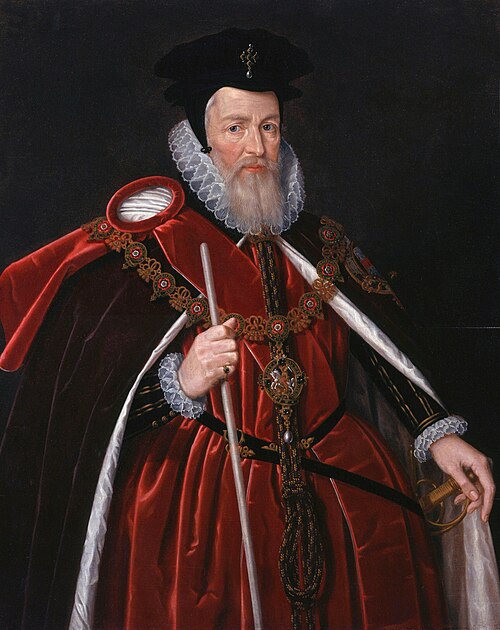
William Cecil, Lord Burghley
1520–1598 · Principal Secretary and Lord Treasurer to Elizabeth I; dies before many of the plays
Occasionally proposed, largely on the grounds that Polonius in Hamlet satirises Burghley and his Precepts. This is a correspondence argument about the source of a character, not an authorship claim. No peer-reviewed or book-length scholarly case argues that Burghley wrote the Shakespeare canon. Fails criterion 1. The chronological constraint (died 1598) is a second independent disqualification.
Candidate Selection Assessment
What the Primary Sources Show
William Cecil served as Elizabeth I’s Principal Secretary and Lord Treasurer for most of her reign, from 1558 until his death in 1598. He was the most powerful administrator in Elizabethan England. His education was substantial, St John’s College Cambridge, followed by Gray’s Inn, and he was a competent Latinist. His Precepts (advice to his son Robert on how to conduct himself in life) circulated widely in manuscript and bear some resemblance to Polonius’s advice to Laertes in Hamlet.
Burghley’s primary source record is extensive; he was the most documented administrator of the age, but none of it connects him to literary composition in the Shakespeare vein. His known writing is administrative, political, and domestic. No literary manuscript, no payment for literary work, no commendatory verses, and no contemporary testimony connects him to the Shakespeare works.
The Polonius connection is exact: Burghley’s Precepts correspond to Polonius’s advice (Hamlet I.iii) in several specific phrases. This is a genuine correspondence; one of the stronger ones in the Shakespearean correspondence literature, and it suggests the author knew Burghley’s text. But it is evidence about a source, not about authorship. It is equally compatible with de Vere (Burghley was de Vere’s guardian and father-in-law), Bacon (who knew Burghley’s circle), and any educated Elizabethan who had access to the widely circulated manuscript.
Not assessed in the framework tables; no qualifying publication exists.
Framework Scores
Scores reflect primary source evidence only. Correspondence, inference, and parallel arguments are not counted, a check mark requires a document.
Open Questions
The Polonius correspondence: what it shows
The correspondence between Burghley’s Precepts and Polonius’s advice is one of the stronger correspondence arguments in the literature, specific, traceable to a documented text, and not easily attributed to coincidence. It is evidence that the author knew Burghley’s Precepts. It is not evidence of who the author was. The Precepts circulated widely in manuscript; Edward de Vere, as Burghley’s ward and son-in-law, had the most direct personal access.
The 1598 problem
Burghley died in August 1598. No full authorship claim can be made without addressing the plays conventionally dated after that point. Kevin Gilvary’s dating audit is relevant but has not been applied specifically to a Burghley candidacy in any peer-reviewed work.