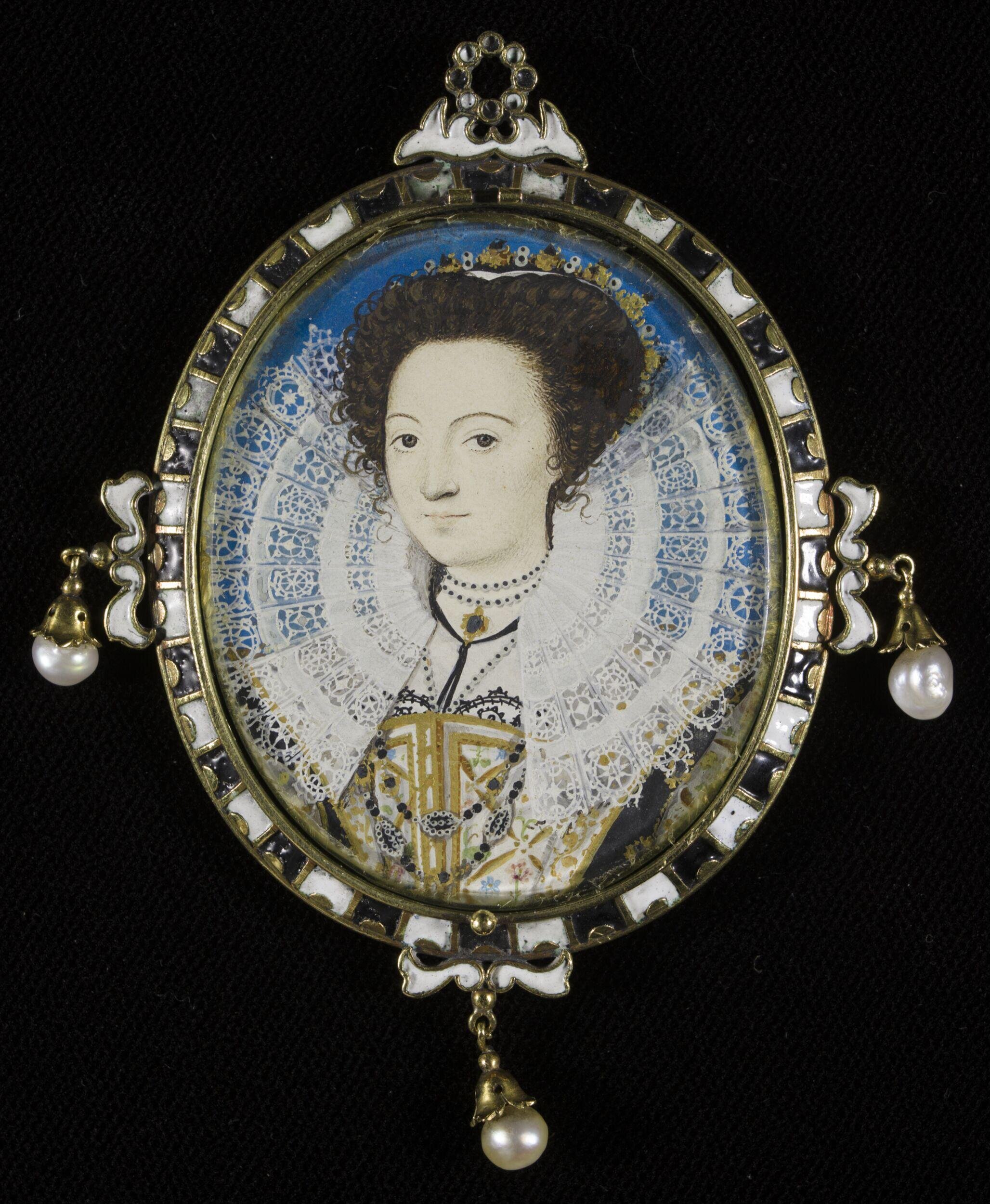
Emilia Bassano Lanier
1569–1645 · London · Venetian musical family · published poet
The Dark Lady identification has substantial scholarly support. The case for Bassano as the primary author of the Shakespeare canon is a preliminary one: the biographical evidence is genuinely interesting, but no publication with independent scholarly reception outside the authorship advocacy community has yet made the full authorship argument and engaged directly with the primary source evidence problem. This page documents what has been established, what has been proposed, and what a qualifying case would need to address.
Scholarly Case Assessment
What the Primary Sources Show
Emilia Bassano was born to Baptista Bassano, a Venetian court musician. The Bassano family were the pre-eminent professional musical ensemble in Elizabethan England, documented in court records across several generations. Italian was her family’s language. Her Venetian heritage gave her a documented connection to the cultural world whose geography, social structures, and music appear in the plays.
She was in Lord Hunsdon’s household, documented in primary sources. Henry Hunsdon was Lord Chamberlain and patron of the Lord Chamberlain’s Men, the company that performed Shakespeare’s plays. She is identified as the dark-complected mistress mentioned in Simon Forman’s casebook (1597). In 1611 she published Salve Deus Rex Judaeorum, a substantial original poem with multiple dedicatory epistles, making her a documented published poet.
Dark Lady identification: what the scholarship establishes
The identification of Emilia Bassano as the Dark Lady of the sonnets has been argued by A.L. Rowse and subsequently developed by several scholars. The evidence is biographical: dark complexion and Italian heritage consistent with the sonnets’ description; Lord Hunsdon household placing her in the same theatrical milieu as the Shakespeare works; documented musical family consistent with Sonnet 128 (the keyboard sonnet). The Dark Lady identification and the authorship claim are separate arguments. The former has substantial scholarly support. The latter is a different and larger claim, that Bassano was not merely the subject of the sonnets but their author, and the author of the entire dramatic canon.
Rowse's original identification (1973) rested partly on a misreading: he took Simon Forman's description of Bassano in his casebook as "brown in youth" as evidence of dark complexion, when the manuscript in fact reads "brave in youth", meaning fine or well turned-out, not dark-skinned. Rowse corrected the error once it was pointed out but continued to defend the identification. Samuel Schoenbaum's dry assessment of the episode, "It is useful for a Dark Lady to be demonstrably dark" (William Shakespeare: A Compact Documentary Life, 1977), is a standing caution against reading the biographical evidence for a match that has already been assumed.
The musical family argument: what the primary sources establish
The Bassano family’s position at the English court is documented primary source history, not biographical inference. Around 1540 Henry VIII’s agent hired all five Bassano brothers as the court’s recorder troupe; court records document the family’s continued presence under Edward VI, Mary, and Elizabeth. Anthony Bassano was a court instrument maker. Amelia’s father Baptista was likely the Queen’s lute teacher. The family’s prominence in Elizabethan court music is attested across multiple generations.
The connection extends directly to the theatrical works. Robert Johnson, documented composer of songs for the Shakespeare plays, including settings for The Tempest and The Winter’s Tale, trained in the household of Lord Hunsdon’s son and was Amelia’s maternal cousin: son of her mother Margaret Johnson’s brother. No other authorship candidate has a documented family connection of this proximity to the composers who set music for the canon.
The plays’ musical knowledge is specific in ways consistent with recorder family background. The Folio text of Hamlet contains a pun on exilent, the technical name for the smallest size of recorder, embedded in Hamlet’s recorder lesson to Guildenstern. This is instrument-specific terminology unlikely to be accessible outside professional recorder circles.
What this establishes: closer documented proximity to the musical world the plays reflect than any other candidate. What it cannot establish alone: authorship. Proximity is a necessary condition for the musical argument, not a sufficient one. The primary source silence problem, no document connecting Bassano to the composition of the works during her lifetime, applies here as everywhere else.
The authorship claim: what remains to be established
The case for Bassano as the primary author of the Shakespeare canon rests on the convergence of biographical evidence: Venetian heritage, musical family, Hunsdon connection, documented literary output. Brooks Martin’s statistical name analysis (2023) adds a quantitative strand. None of this is frivolous. But the central evidentiary problem, that no primary source document connects Bassano to the composition or circulation of the works during her lifetime, has not been directly addressed by the existing scholarly case. By paper trail framework standards, the literary paper trail is thin compared with Florio, Bacon, or Mary Sidney Herbert: no literary correspondence, no library record, no commendatory verses exchanged with major literary figures.
Statistical name analysis: Martin (2023)
Brooks Martin’s Ms Shakespeare I Presume (2023) presents a name scoring of Shakespeare’s characters against Bassano-adjacent names and family members. Across 60 characters, Bassano-adjacent names cluster strongly with heroic characters; Shakspere-adjacent names cluster with villains and fools. Statistical analysis was performed by Dr. Daniella R. Recchia. The observation that the character-naming pattern is non-random is a real finding. What the statistical test cannot establish is who caused the pattern: the inference from “non-random” to “Bassano caused it” requires an additional premise, that she is the only plausible source, which the statistics do not supply. The decisive methodological difficulty is the proxy identification problem: names like Iago (→ lago di Garda) and Othello (→ “other Bassano”) are identified as proxies precisely because they already resemble Bassano-adjacent concepts, inflating both the score and the apparent statistical independence of observations. The name-clustering observation is noted as a convergence signal of genuine interest; it does not constitute a probability proof of authorship.
Challenges the authorship case must address
The feudal/aristocratic insider perspective of the history plays is the hardest evidence for any non-aristocratic candidate to explain. The Ovidian erotic register of the early works sits awkwardly alongside the devotional register of Salve Deus. The sustained male narrative persona in the sonnets and plays is unexplained. A qualifying scholarly case would need to engage with each of these directly.
Now assessed in the framework tables, but preliminary: a qualifying publication engaging the primary source silence on the terms this site requires has not yet appeared.
Framework Scores
These scores document Bassano’s evidential position against the two frameworks. They reflect the available primary source evidence, not a validated authorship assessment.
Scores reflect primary source evidence only. Correspondence, inference, and parallel arguments are not counted, a check mark requires a document.
Open Questions
A qualifying authorship publication
The most important gap is not biographical but scholarly: no publication with independent scholarly reception outside the authorship advocacy community has made the full authorship argument and engaged directly with the primary source evidence problem, why no document connects Bassano to the works during her lifetime. A publication that addresses this directly, rather than routing around it, would change the assessment immediately.
The primary source silence
By paper trail framework standards, Bassano has no literary correspondence, no library record, no payment for literary work, and no commendatory verses exchanged with major literary figures. This is the same pattern Price identifies for Shakspere of Stratford. A qualifying authorship case must either explain this silence with documented historical circumstances or find primary source evidence that fills it.
The feudal/aristocratic insider problem
The plays display detailed insider knowledge of aristocratic and feudal culture, heraldry, tournament protocol, feudal obligation, court hierarchy, not as set dressing but as structural assumptions about how that world works from the inside. This is a genuine evidential question for any non-aristocratic candidate. The relevant question is not whether Bassano was born into the aristocracy; it is whether she had documented access to that world at the level the plays reflect. Her Hunsdon household connection is documented. Whether it provided access of the required scope has not been established in primary sources. Primary source evidence of the extent of her Hunsdon connections would be directly relevant.
The musical family evidence: what it establishes
The Bassano family’s professional court musician status is Bassano’s single most discriminating biographical evidence; it uniquely documents the professional musical knowledge reflected in the plays. A detailed musicological comparison of the plays’ technical musical language with documented Bassano family instruments, repertoire, and traditions would clarify whether this convergence holds at the level of specific documented knowledge, or only at the level of general musical familiarity.