Francis Bacon
1561–1626 · Lord Chancellor · philosopher · essayist · Gray's Inn
Historically the most prominent heterodox candidate. His literary paper trail is among the strongest of any candidate assessed here; he was a major documented writer with an exceptional classical education and unparalleled legal knowledge. His weaknesses under the convergence analysis are equally significant: no documented Italian travel, no dedication-period Southampton connection, and a documented literary voice, aphoristic, impersonal, philosophical, markedly unlike the emotionally varied dramatic register of the plays.
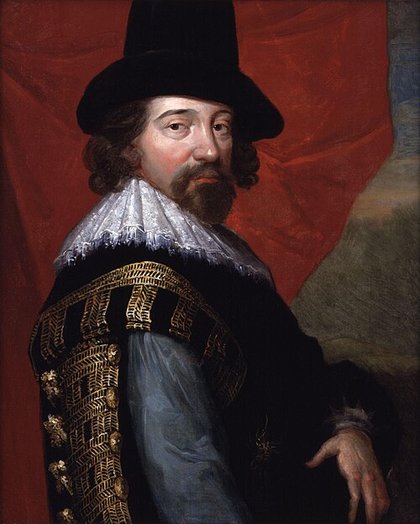
What the Primary Sources Show
Francis Bacon was born in 1561, the son of Nicholas Bacon, Lord Keeper of the Great Seal. He entered Trinity College Cambridge at twelve and studied at Gray's Inn from 1576. He served briefly in France with the English ambassador before his father's death returned him to England. His public career culminated in appointment as Lord Chancellor in 1618, followed by conviction for accepting bribes and removal from office in 1621. He died in 1626, officially while conducting experiments on preservation by cold.
His published literary output under his own name is substantial and documented: the Essays (first edition 1597; expanded 1612 and 1625), The Advancement of Learning (1605), Novum Organum (1620), New Atlantis (published posthumously 1627), and extensive philosophical and legal writings. He was praised by Ben Jonson in Timber: "He seemed to me ever, by his work, one of the greatest men, and most worthy of admiration, that had been in many ages." His literary paper trail is among the richest of any candidate, education, correspondence, manuscripts, payment, and death notice all documented.
The Promus
The most specific piece of Baconian primary source evidence is the Promus of Formularies and Elegancies, a private commonplace book compiled by Bacon, held at the British Library (Harleian MS 7017), dateable to approximately 1594–96. It contains roughly 1,600 entries: proverbs, idioms, aphorisms, turns of phrase, drawn from multiple languages. A significant number of these phrases appear in the Shakespeare plays and poems, often in the same context and with the same application.
The Promus is a primary source document. It is not a cipher, not an inferred connection; it is Bacon's own hand, in his own notebook, containing phrases that appear in the Shakespeare works. The question is whether the overlap reflects shared literary culture (both drawing on common proverbial material) or something more direct. The phrases are not uniformly rare, some are common Elizabethan idiom. Others are more specific. The Promus deserves to be assessed as convergence evidence, not dismissed and not overstated.
The Northumberland Manuscript
A second primary source connection, less specific than the Promus but contemporaneous, is the Northumberland Manuscript, a parchment folder compiled c.1596–97, discovered at Northumberland House in 1867 and now held at Alnwick Castle. The folder originally contained six Bacon manuscripts (essays, speeches, Gray's Inn revels material) together with copies of Richard II and Richard III. The cover page has both "Francis Bacon" and "William Shakespeare" written on it multiple times in a scribal hand. It is the only known Elizabethan document placing both names on a single page. Northumberland Manuscript, Shakespeare Documented.
The evidential status is limited but real. The orthodox reading is that Bacon simply had copies of the plays, as any educated Elizabethan might. The name repetitions on the wrapper are likely scribal identification of the contents. Neither reading makes the document negligible: a collection that physically binds Bacon's own writings with Shakespeare play copies, compiled in his lifetime, is documented contemporaneous association. It is not the Promus, but it is not nothing.
The Style Problem
The single most significant weakness of the Baconian case is the documented difference between Bacon's literary style and the Shakespeare works. Bacon's prose is characterised by aphorism, Latin syntactic structure, systematic organisation, and philosophical precision. The Essays are spare and impersonal. The plays are organic, emotionally immediate, rhetorically varied, and often structurally loose in ways Bacon's documented writing never is. This is not a trivial stylistic preference; it is a fundamental difference in how language operates in the two bodies of work.
The Cipher Theories
Baconian advocacy has historically centred on cryptographic arguments: acrostics, bi-literal ciphers, numerical codes embedded in the First Folio (Ignatius Donnelly, 1888; Elizabeth Wells Gallup, 1899). These arguments are excluded from this assessment by the governing evidentiary rule: primary source documentary evidence only. No independent cryptographer has validated any Baconian cipher, and the methodological objections to the cipher approach are decisive. The cipher theories are noted here to explain their absence from the framework scores, not to dismiss the Baconian case as a whole.
Best-documented legal knowledge of any candidate. The Ovidian erotic literary voice is contrary to his entire documented persona.
Framework Scores
Scores reflect primary source evidence only. Correspondence, inference, and parallel arguments are not counted, a check mark requires a document.
Open Questions
The Southampton gap
The dedications of Venus and Adonis (1593) and Lucrece (1594) to Southampton are two of the most specific primary source documents in the authorship question. One primary source connects Bacon to Southampton personally: a letter, printed in Spedding’s Letters and Life of Francis Bacon, that Bacon wrote to Southampton at James’s accession in 1603, as Southampton left the Tower, a careful approach toward reconciliation from the man who had helped prosecute him and Essex two years earlier, assuring him that “I may safely be that to you now, which I was truly before.” No reply is recorded. What the letter documents is acquaintance and estrangement, a decade after the dedications. What the dedication period requires, a relationship in 1593–4 capable of supporting the warmest dedications of the age, remains undocumented, and Bacon’s documented route to Southampton ran through Essex, whom he served and then prosecuted. The constraint stands in this more precise form.
The Italian evidence gap
If the field-verified Italian topographical accuracy of the plays (Roe 2011) requires direct personal knowledge of Italy, this is a significant problem for Bacon. What the primary record documents is three years in France (1576–79) in Sir Amias Paulet’s embassy, and a plan to travel on into Italy in February 1579 that was cut short when his father died and he was recalled, an intended Italian journey, not a completed one. The one source that sends him further, Pierre Amboise’s Discours sur la vie de François Bacon (1631), is late, second-hand, and demonstrably unreliable where it can be checked; it dresses Bacon’s plain ancestry in an illustrious lineage it never had, so it cannot carry the Italy claim on its own. What would change the assessment is a contemporary source placing Bacon in Italy, or evidence the 1579 plan was carried out; knowledge of Italy acquired through books, dispatches, and the embassy is not the same as travel.
The Promus as convergence evidence
The Promus (British Library Harleian MS 7017, c.1594–96) is the most specific primary source argument for Bacon. A systematic analysis distinguishing genuinely rare Promus phrases from common Elizabethan idiom, and tracing those rare phrases specifically into the Shakespeare works, would establish the evidential weight of this material more precisely than it has been established to date. The existing scholarship (Mrs Henry Pott, 1883; Durning-Lawrence, 1910) predates modern corpus linguistics. A rigorous modern study would be significant in either direction.
The Northumberland Manuscript: what a proper analysis would establish
The Northumberland Manuscript (Alnwick Castle, c.1596–97) has been discussed primarily by Baconian advocates and largely ignored by mainstream scholarship. A rigorous codicological study, examining the scribal hand, the sequence of assembly, which materials were added when, and the precise relationship between the Bacon papers and the Shakespeare play copies, would establish what the document actually shows. Specifically: were the plays copied by Bacon's own secretarial staff? Is the name repetition on the cover a scribal index or something else? The document is primary source material that deserves neutral scholarly attention it has not received.
Documented habit of masked publication
Bacon's documented practice of publishing under pseudonyms or without attribution in some works is a primary source fact. His Advertisement Touching the Controversies of the Church of England (c.1589) circulated anonymously; he discussed veiled writing explicitly in the Advancement of Learning. Whether this practice extended to dramatic works, and whether primary source evidence connects it to the name 'Shakespeare' specifically, is unresolved. The habit of concealment is documented; its application to the authorship question is not.